Email Became Infrastructure. The Operating Model Did Not.
Security and IT are responsible for business-critical email, but they often learn something changed only after a ticket, alert, security finding, or delivery failure. Then the investigation begins.
Your email ecosystem — right now
Marketing launched a high-volume cold email campaign
A vendor changed its sending infrastructure
Support moved customer notifications to a new platform
A business team connected a new SaaS sender
Email Is Still Operated From the Incident Backward.
Business email depends on a deep stack of domains, DNS, authentication, sending systems, reputation, receiver behavior, and threat exposure. Different teams own different pieces, but Security and IT are still expected to explain the outcome when something goes wrong.
The Ecosystem Changes Outside Your View
Business teams and vendors can change sending behavior, infrastructure, and authentication conditions without Security or IT initiating or even seeing the change.
The Change Is Discovered Through Its Consequences
By the time it's visible, it usually shows up as one of these.
Ticket / Alert / Security Finding
The team has the symptom. It still has to reconstruct what changed, where it started, what it affected, whether it is legitimate, and who owns the next action.
The investigation tax
Security and IT work backward through the email ecosystem.
What changed?
Where did it start?
What is affected?
Who owns the next action?
The incident becomes the monitoring system. That is the operating-model failure.
The Problem Is Not Just Too Many Tools. It Is How Email Is Operated.
01
Ownership Gap
Every team owns a piece. No department owns email as a whole. Security, IT, Marketing, Product, and vendors may each manage their part effectively, but end-to-end ownership of the email ecosystem is usually missing.
02
Fragmented
The system is connected. The operating view isn't. DNS, authentication, senders, reputation, delivery, and threats influence the same business email ecosystem, but teams usually investigate them separately.
03
Reactive
You learn about change from its consequences. By the time a ticket, alert, mailbox provider, or business team exposes the problem, impact may already be visible.
04
Expensive to Investigate
Every incident starts with reconstruction. Teams must determine what changed, what it affected, whether it is legitimate, and who owns the response before they can confidently act.
Run Email Like the Critical Infrastructure It Has Become.
Email Trust gives Security and IT a continuous operating model for ingesting the signals across the email ecosystem, turning them into prioritized context, and taking the right action.
Ingest every signal.
Build a continuous view of the email ecosystem.
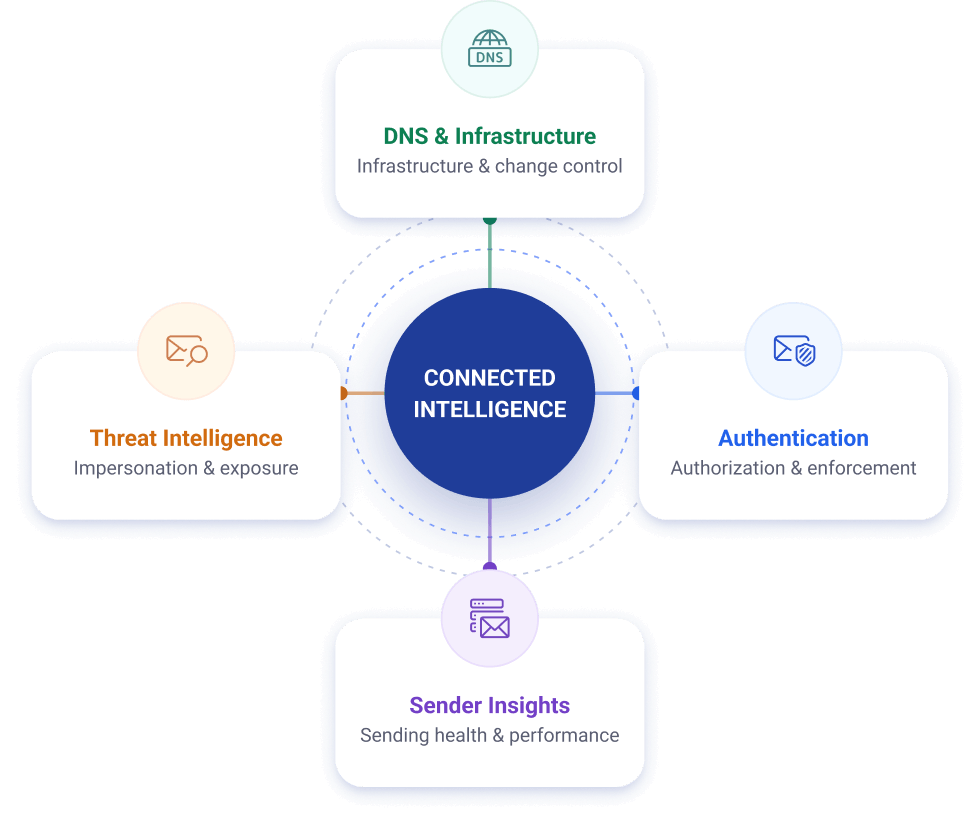
DNS, authentication, senders, reputation, delivery signals, and threats are continuously collected into the same operating context. Security and IT no longer have to check systems separately to know what is happening.
Correlate every signal.
Assess and prioritize what matters.
Signals and changes are evaluated together to determine what is related, what is affected, how important it is, and who should own the response. Raw signals become prioritized issues with the context needed to act.
Take the right action.
Act with context.
Correct, authorize, remediate, route, or approve the required action with the surrounding state already understood. Action happens where the issue actually lives.
This is Email Trust.
A continuous operating model for business-critical email.
The Platform Built to Run Email Trust.
EasyDMARC connects the signals behind business email so Security and IT can see what is happening, understand what matters, and act with context.
Coverage across the email ecosystem
Across the platform
Connected Intelligence correlates the signals. Alerting surfaces what matters. AI Agent helps teams investigate and act. Integrations, API, and MCP extend Email Trust into the rest of the stack. Governance keeps changes controlled and attributable.
Security
Security under control
Delivery & Deliverability
Legitimate email performing as expected
Governance & Control
Changes visible, attributable, and controlled
Security and IT Share the Model. Their Responsibilities Stay Different.
Email Trust does not blur ownership. It gives both teams the operating context they need before they investigate or act.
See Risk With the Surrounding Email Context.
Today
Threat, authentication, and abuse findings arrive separately. Security must find the infrastructure and sender context before it can judge what matters.
With Email Trust
See suspicious activity alongside the affected domains, authentication state, senders, and infrastructure so legitimacy and impact are clearer earlier.
Start Troubleshooting With the State Already Known.
Today
A ticket triggers checks across DNS, authentication, senders, and reputation, plus questions to other teams about what changed.
With Email Trust
See the meaningful change, affected systems, surrounding state, and likely owner before troubleshooting begins, then verify the result after action.
Shared operating context. Clear responsibility. Less reconstruction.
Built for Teams Responsible for Business-Critical Email.
Operate email continuously instead of reconstructing it every time something breaks.
90,000+
organizations
9B+
signals analyzed daily
8+ years
of email infrastructure intelligence