



Email deliverability is often reduced to a simple question: Did the email send?
But for anyone who relies on email to communicate with customers, partners, or users, the real question is far more important: Did the email actually reach the inbox, and why/why not?
Modern inbox providers don’t make delivery decisions based on a single factor. They evaluate hundreds of technical and behavioral signals before deciding whether an email belongs in the inbox, the spam folder, or nowhere visible at all. This is why email deliverability testing cannot be treated as a one-time activity. It is an ongoing process that blends technical checks, sender-reputation analysis, and real-world inbox behavior.
In this article, we’ll break down:
- What email deliverability testing really means in practice
- Why single-email testing tools are usually the starting point
- Where one-off tests fall short
- How organizations move toward continuous deliverability monitoring as email programs grow
What Is Email Deliverability (and What It Is Not)
Email delivery and email deliverability are often used interchangeably, but they describe two very different outcomes. Email delivery simply means that the receiving mail server accepted your message.
Email deliverability test, however, determines what happens after that acceptance; whether the email is actually visible to the recipient or quietly pushed out of sight.
In practice, that means an email may land in:
- The primary inbox
- The spam or junk folder
- A secondary tab like Promotions
Or it can be silently filtered or throttled before the user ever sees it.
This is why delivery success alone is a misleading metric. An email can be successfully delivered at the protocol level and still completely fail its real purpose if it never reaches the inbox or gets ignored by the recipient. Delivery gets the email in the door. Deliverability decides whether it’s actually seen.
Inbox providers decide placement by evaluating a combination of technical trust signals and real-world behavior over time. These signals are typically grouped into four core pillars:
- Authentication – Whether SPF, DKIM, and DMARC are correctly configured and aligned.
- Infrastructure and reputation – The historical trust of the sending domain and IP addresses
- Message signals – Headers, formatting, structure, and content patterns
- Recipient feedback – Engagement, bounces, spam complaints, and user behavior
All four work together. A weakness in any one area can affect inbox placement, even if everything else looks correct.
Why Single-Email Testing Tools Are Often the First Step
Most teams start their email deliverability journey with single-email testing tools because they answer a very practical early question: “Is there anything obviously wrong with this email before it goes out?”
At this stage, the goal is not long-term analysis. It is basic validation. These tools analyze a single test message and surface issues that could immediately block or degrade delivery if left unchecked. They help teams catch mistakes that are easy to overlook but costly once emails are sent to real recipients.
A typical single-email deliverability test provides visibility into:
- Basic spam filter signals that may trigger filtering
- Whether SPF, DKIM, and DMARC are present and syntactically valid
- Known blacklist or blocklist listings tied to the sending domain or IP
- Header structure, MIME formatting, and other technical inconsistencies
A well-known example in this category is mail-tester.com, which is commonly used for quick checks and early-stage troubleshooting.
Single-email testing tools are most useful in scenarios such as:
- Catching obvious configuration errors before sending to a real audience
- Verifying SPF, DKIM, and DMARC are present and roughly correct
- Identifying glaring spam-triggering content or formatting issues
- Checking whether a sending IP or domain is listed on major blacklists
Used correctly, these tools act as a diagnostic checkpoint rather than a guarantee of inbox placement. They help identify clear configuration, formatting, or structural issues early, reducing the risk of pushing broken or misaligned emails into production at scale.
The Limits of One-Off Deliverability Tests
While helpful, single-email tests only provide a snapshot. They cannot show how your email program performs in the real world over time.
They do not reliably reveal:
- Inbox placement differences across Gmail, Outlook, Yahoo, and other providers
- How sender reputation changes week over week
- How inbox providers respond to higher sending volumes
- Differences between multiple sending tools or platforms
- Long-term DMARC alignment and policy enforcement trends
Inbox providers do not judge senders based on isolated messages. They look for patterns, consistency, and historical behavior across thousands or millions of emails.
This is where many teams get stuck; emails “pass tests” but still fail to reach the inbox consistently.
Inbox Placement vs Spam Scoring
Spam scoring and inbox placement are often treated as the same thing, but they measure very different outcomes.
- Spam scoring estimates how risky an email appears based on individual signals
- Inbox placement shows where emails actually land for real recipients
An email can:
- Pass authentication checks
- Receive a low spam score
- Still land in spam due to poor domain reputation or misaligned authentication over time
This is why effective email deliverability testing must move beyond asking, “Does this email look okay?” and instead focus on “How is my domain performing over time across providers?”
Email Authentication: The Foundation of Deliverability
All meaningful deliverability testing starts with authentication. Mailbox providers use SPF, DKIM, and DMARC to establish who you are, whether you’re authorized to send, and whether your messages can be trusted.
Without proper authentication in place, inbox placement data, engagement metrics, and reputation signals become noisy or misleading because the sender identity itself is not clearly defined. An email header analyzer helps validate sender identity and authentication status directly from email metadata.
SPF
SPF (Sender Policy Framework) defines which mail servers are authorized to send email on behalf of your domain. It works by publishing a list of approved sending sources in DNS, allowing receiving mail servers to verify that incoming messages are from legitimate sources. If an email is sent from a server that is not listed in SPF, inbox providers may flag it as suspicious or reject it outright.
DKIM
DKIM (DomainKeys Identified Mail) uses cryptographic signatures to confirm that an email has not been modified in transit and that it genuinely originates from the stated domain. Each message is signed with a private key, and receiving servers use a public key published in DNS to validate that signature.
When DKIM passes, inbox providers gain confidence that the message content is authentic and unchanged. DKIM is particularly important for protecting message integrity and building long-term domain reputation, especially for high-volume or transactional senders.
DMARC
DMARC (Domain-based Message Authentication, Reporting, and Conformance) ties SPF and DKIM together and adds policy and visibility on top of them. It tells inbox providers:
- How SPF and DKIM alignment should be enforced
- What action to take when authentication checks fail (none, quarantine, or reject)
- Where to send aggregate and forensic reports for monitoring and analysis
Single-email testing confirms that these records exist and are correctly configured. Long-term deliverability depends on how they perform across real sending volume.
From Testing to Monitoring: When Deliverability Becomes Operational
As email programs scale, the most common risks come from:
- Gradual reputation erosion caused by declining engagement over time
- Inconsistent sending patterns that trigger mailbox provider distrust
- Authentication misalignment due to infrastructure changes or new sending sources
- Silent inbox placement shifts that go unnoticed without ongoing monitoring
- List quality decay as inactive or low-intent subscribers accumulate
At this stage, organizations move beyond basic testing and adopt continuous deliverability monitoring. The focus shifts from checking individual emails to understanding how an entire domain behaves across providers and over time.
Continuous monitoring typically includes:
- Aggregated DMARC report analysis to understand authentication results at scale
- Visibility into all sending sources using the domain, including third-party tools and shadow senders
- Ongoing SPF and DKIM alignment tracking to catch silent failures and configuration drift
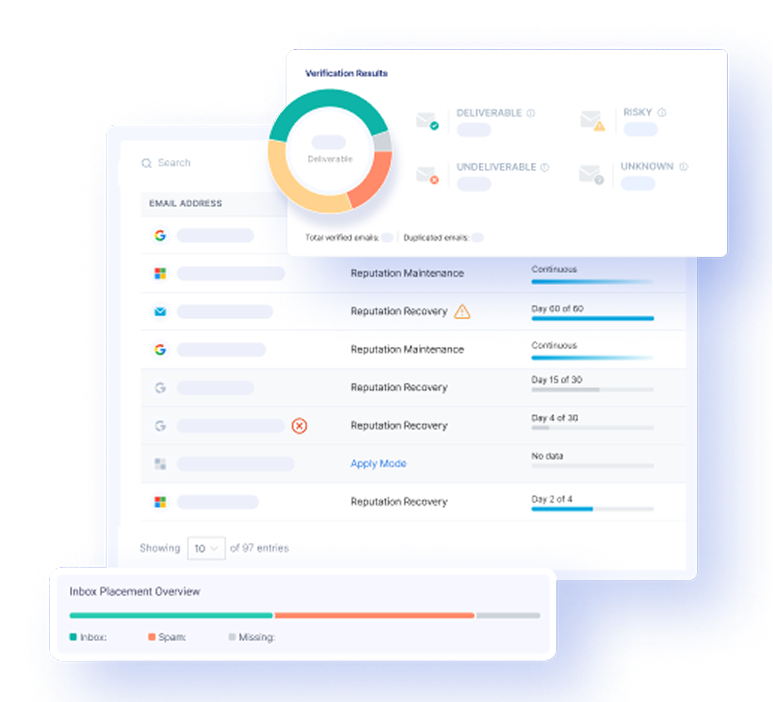
- Inbox placement trends broken down by mailbox provider
- Alerts when authentication, configuration, or sender reputation changes
This is where dedicated deliverability and DMARC monitoring platforms like EasyDMARC naturally come into play. Instead of relying on isolated tests or manual log reviews, these platforms centralize authentication data, surface trends that are invisible at the message level, and provide ongoing visibility into how inbox providers are evaluating a domain.
How Testing and Monitoring Work Together
Single-email testing tools and continuous monitoring platforms are not competitors. They serve different purposes.
A practical workflow often looks like this:
Single-email testing
- Quick diagnostics
- Template and configuration validation
- Early-stage issue detection
Continuous monitoring
- Domain-level visibility
- Long-term reputation tracking
- Protection against spoofing and unauthorized sending
When used together, they provide both immediate feedback and long-term insight.
When to Use Each Approach
| Scenario | Best Approach |
|---|---|
| Testing a new email template | Single-email testing |
| Verifying SPF/DKIM/DMARC changes | Single-email testing |
| Investigating spam filter feedback | Single-email testing |
| Managing multiple sending tools | Continuous monitoring |
| Protecting brand domains | Continuous monitoring |
| Scaling email volume safely | Continuous monitoring |
Final Thoughts
Email deliverability is not a checkbox; it’s a system that evolves over time.
Single-email testing tools are valuable for identifying obvious problems and validating configurations. But consistent inbox placement depends on long-term visibility, strong alignment with authentication, and continuous domain-level monitoring.
The most resilient email programs combine early diagnostics with ongoing oversight and treat deliverability as a living process rather than a one-time fix.

 We’re glad you joined EasyDMARC newsletter! Get ready for valuable email security knowledge every week.
 You’re already subscribed to EasyDMARC newsletter. Continue learning more about email security with us


