
As organizations mature their email security posture, DMARC is no longer treated as a standalone authentication protocol. Instead, it becomes a valuable source of security intelligence that needs to be visible across the broader security ecosystem. DMARC monitoring platforms generate detailed insights about authentication failures, spoofing attempts, and sending infrastructure, but this data is most effective when it does not remain isolated.
This is where a DMARC solution with API integration plays a critical role. APIs enable organizations to connect DMARC reporting data with SIEM platforms, internal dashboards, and security monitoring tools, making email authentication data usable within security workflows. By integrating DMARC data into existing workflows, security teams can improve visibility, correlate threats across systems, and support faster investigation and response.
Why DMARC Data Needs to Integrate With Security Operations
DMARC reporting provides more than just email authentication insights, as it generates valuable security data that can support broader threat detection and monitoring efforts. For many organizations, the real value of DMARC comes from making this data accessible within existing security operations, where it can be analyzed alongside other signals and acted on in real time.
Email authentication data as a security signal
DMARC aggregate reports reveal patterns such as unauthorized sending sources and alignment failures across SPF and DKIM that may indicate misconfigurations or unauthorized sending activity.
These insights help security teams identify suspicious activity targeting their domains. When combined with other telemetry, such as login anomalies or network alerts, DMARC data can support broader threat analysis when combined with other security signals.
The limitations of isolated DMARC dashboards
When DMARC data remains confined to a single platform, it can be harder for security teams to respond quickly or correlate findings with other incidents. Teams may need to switch between tools, which slows down investigation and response times. Integrating DMARC data into existing security systems allows organizations to centralize visibility, streamline workflows, and improve coordination across security operations.

What a DMARC Solution With API Integration Provides
Modern DMARC platforms extend beyond dashboards by offering API access to their underlying data. This allows organizations to connect DMARC monitoring insights with other systems and use them within their own workflows. A DMARC solution with API integration primarily provides access to parsed DMARC reporting data and domain authentication insights.
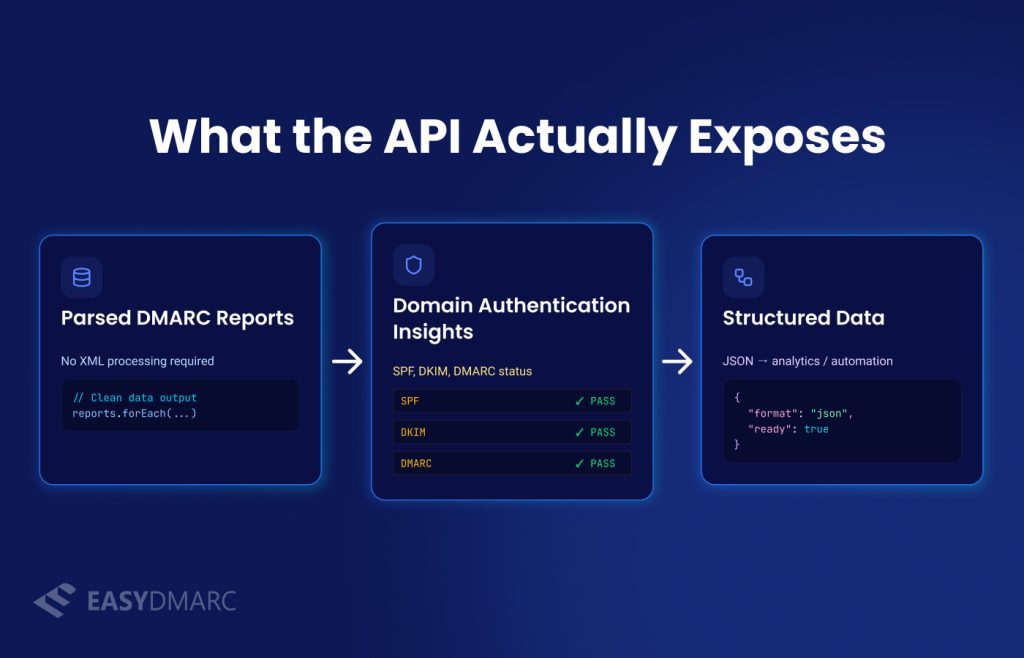
Programmatic access to DMARC reporting data
APIs allow organizations to retrieve parsed DMARC aggregate reports, authentication results, and sender activity without manually handling raw XML files. This makes it easier to build custom dashboards, automate reporting, or feed data into internal monitoring systems used by security and compliance teams.
Access to domain authentication insights
Organizations can use APIs to pull information about DMARC, SPF, and DKIM configuration status across multiple domains. This helps security teams monitor authentication posture at scale and quickly identify misconfigurations or gaps that could expose domains to spoofing risks.
Structured data for analytics and automation
DMARC APIs typically deliver data in structured formats such as JSON. This makes it easier to integrate the information into analytics platforms, reporting pipelines, or internal security tools. Structured data supports automation, enabling teams to create workflows that react to authentication issues or suspicious sending activity in a consistent and scalable way.
How DMARC APIs Integrate With Security Tools
Organizations use DMARC APIs to connect email authentication data with the tools that power their security operations. Instead of reviewing DMARC insights in isolation, teams can integrate this data into systems where monitoring, alerting, and response already take place.
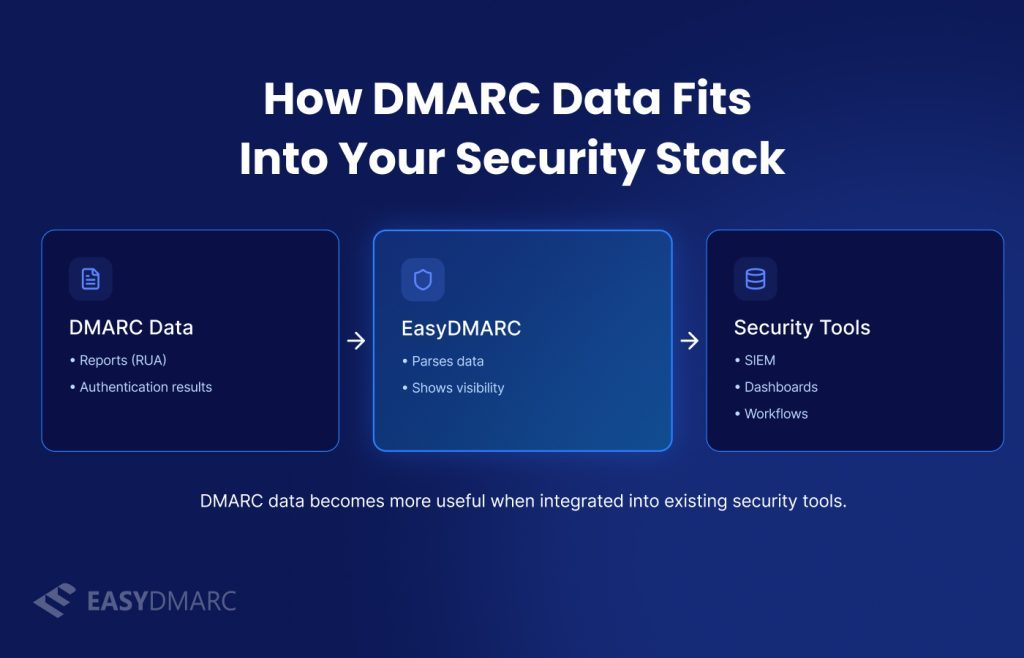
SIEM platforms
DMARC insights can be forwarded into SIEM platforms, where they are analyzed alongside other security telemetry such as network activity, endpoint alerts, and identity signals. This allows security analysts to detect spoofing attempts in context and investigate them as part of a broader threat landscape. Centralizing this data improves visibility and helps teams prioritize incidents.
Security orchestration and response workflows
DMARC data can be used within workflows that trigger automated or semi-automated actions. For example, repeated authentication failures or unknown sending sources may prompt investigations, validation of sending services, or updates to email authentication policies. Integrating DMARC insights into these workflows helps teams respond faster and reduce manual effort.
Governance and compliance monitoring
DMARC reporting data supports governance and compliance efforts by providing visibility into authentication coverage and policy enforcement across domains. Security teams often include this information in audit reports or internal dashboards to track progress and demonstrate alignment with security standards. Integrating this data into compliance workflows ensures consistent monitoring and reporting across the organization.
Key Capabilities to Look for in a DMARC API
When evaluating a DMARC solution with API integration, organizations should focus on how well the API supports security operations, data accessibility, and reliable integration. The goal is not just to access data, but to ensure it can be used effectively within existing security and compliance workflows.
Access to parsed DMARC reports
APIs should provide access to normalized DMARC aggregate report data so teams do not need to process raw XML files themselves. Parsed data allows security teams to quickly analyze authentication results, identify sending sources, and detect anomalies without additional preprocessing.
Domain and policy monitoring data
A strong DMARC API should expose domain-level authentication insights, including DMARC policy status, SPF and DKIM alignment, and known sending sources. This helps organizations monitor their authentication posture across multiple domains and quickly identify gaps or misconfigurations.
Secure authentication and access controls
API access should include secure authentication mechanisms such as API keys or tokens, along with role-based access controls. Logging and access visibility are also important so organizations can track how data is accessed and ensure it aligns with internal security policies.
Integration flexibility
DMARC APIs should support integration with SIEM platforms, monitoring systems, and internal analytics tools. Clear documentation, stable endpoints, and consistent data availability are essential for operational use, especially for teams that rely on continuous data flows for monitoring and reporting.

How EasyDMARC Supports Security Ecosystem Integration
Organizations looking for a DMARC monitoring service for enterprises with API integration often need more than just data access. They need a platform that fits into their existing security environment and supports visibility, monitoring, and operational workflows at scale. EasyDMARC is designed with this in mind, helping security teams integrate DMARC insights into broader infrastructure without adding complexity.
Integrations with enterprise infrastructure
EasyDMARC helps organizations integrate DMARC monitoring into their existing systems like DNS providers, email platforms, and security monitoring tools. This allows organizations to extend DMARC visibility across their environment and connect authentication data with the systems they already use.
Teams can extend this further through the DMARC integrations, which support connecting DMARC monitoring data with internal tools and external security platforms. This enables centralized visibility and more efficient workflows across security operations.
DMARC visibility for large domain portfolios
Managing DMARC across multiple domains and sending services can quickly become complex, especially in enterprise environments. EasyDMARC provides visibility into authentication results, sending sources, and alignment issues across large domain portfolios.
This is particularly valuable for organizations managing multiple domains and sending services. DMARC for Enterprise centralizes monitoring and helps security teams maintain consistent policies and quickly detect anomalies across distributed infrastructures.
Compliance-ready reporting and monitoring
EasyDMARC also supports organizations that need structured reporting for governance and compliance programs. It provides clear visibility into authentication coverage, policy enforcement, and domain activity, helping teams track progress and prepare for audits.
For organizations focused on compliance readiness, this aligns with best practices outlined in DMARC service with compliance readiness, where consistent monitoring and documentation play a key role in maintaining a strong email security posture.
When Organizations Benefit Most From API-Enabled DMARC Solutions
Not every organization needs deep integration from the start, but as email infrastructure and security operations become more complex, API enabled DMARC solutions provide significant advantages. They are especially valuable for teams that require centralized visibility, automation, and scalable monitoring across multiple systems.
Enterprise security teams
Large organizations often operate complex security environments with multiple tools, dashboards, and monitoring systems. For these teams, integrating DMARC data into existing workflows helps ensure that email authentication insights are not overlooked.
By feeding DMARC data into SIEM platforms and internal dashboards, enterprise security teams can correlate spoofing attempts with other threat signals, improve incident response, and maintain consistent visibility across their infrastructure.
Managed security providers and multi-domain environments
Managed service providers and MSSPs often monitor multiple domains, client environments, and email infrastructures at the same time. API access allows them to aggregate DMARC insights across environments and centralize monitoring within their own systems.
This approach supports scalable operations, making it easier to track authentication status, identify suspicious activity, and manage multiple domain portfolios without relying on separate dashboards for each environment.
Making DMARC Data Part of Your Security Stack
DMARC monitoring delivers valuable insight into authentication failures, spoofing attempts, and sending infrastructure, but its impact grows when that data becomes part of a broader security workflow. Integrating DMARC insights with SIEM platforms, internal dashboards, and monitoring systems helps organizations move from isolated reporting to operational visibility.
A DMARC solution with API integration allows security teams to use email authentication data in a more practical and scalable way. With the right platform, organizations can improve monitoring, support compliance efforts, and strengthen the role of DMARC in their overall security strategy. EasyDMARC makes this possible by providing teams with the visibility and integration support needed to manage email security across modern environments.
FAQ
A DMARC API allows organizations to access DMARC monitoring data programmatically instead of only through a dashboard. It is used to retrieve aggregate reports, authentication results, and domain insights, which can then be integrated into internal systems. Security teams often use DMARC APIs to feed data into SIEM platforms, build custom dashboards, or automate monitoring workflows.
Yes, DMARC data can be integrated with SIEM platforms through API access. This allows security teams to analyze email authentication activity alongside other security signals such as network events or login anomalies. By combining these data sources, organizations gain better visibility into spoofing attempts and can investigate incidents within a centralized monitoring environment.
Through a DMARC API, organizations can access parsed aggregate reports, authentication results, sending source information, and domain-level insights. Many platforms also provide visibility into SPF and DKIM alignment, DMARC policy status, and domain configurations. This data helps security teams monitor authentication posture and detect suspicious sending activity across their domains.
Enterprises integrate DMARC monitoring with their security tools to improve visibility and response times. When DMARC data is included in broader security workflows, teams can correlate email authentication issues with other threats. This helps identify spoofing attempts faster, reduces manual investigation, and maintains consistent monitoring across complex infrastructures with multiple domains and systems.
EasyDMARC supports enterprise email security monitoring by providing centralized visibility into authentication results across multiple domains and sending services. It also enables integration with existing infrastructure, allowing teams to include DMARC insights in their security workflows. This helps organizations monitor domain activity, detect anomalies, and maintain consistent email authentication policies at scale.
Yes, DMARC monitoring remains essential even after a DMARC record is configured. A policy alone does not guarantee full protection, as sending sources and configurations can change over time. Continuous monitoring helps organizations track authentication performance, identify unauthorized senders, and ensure policies are enforced correctly across all domains and email services.

 We’re glad you joined EasyDMARC newsletter! Get ready for valuable email security knowledge every week.
 You’re already subscribed to EasyDMARC newsletter. Continue learning more about email security with us