
Organizations today face a growing number of email-based threats, from domain spoofing to phishing campaigns that attempt to impersonate trusted senders. While DMARC helps enforce authentication policies and generate visibility into these threats, its full value is often limited when monitoring data remains isolated within a single platform. Security teams increasingly need this data to be part of their broader security operations, alongside logs, alerts, and telemetry from other systems.
This is where DMARC API integrations become essential. By exposing DMARC monitoring data through APIs, organizations can connect authentication insights with SIEM platforms, internal dashboards, and security analytics tools. This allows teams to move beyond passive monitoring and treat DMARC data as a security signal within broader workflows, improving visibility into spoofing attempts and supporting threat detection workflows.
Why DMARC Data Should Be Part of Your Security Stack
DMARC reports provide a continuous stream of insights into how your domains are being used across the internet. They capture authentication outcomes, sending sources, and policy enforcement results, all of which are directly relevant to security teams monitoring for abuse. When this data is integrated into a broader security stack, it becomes a valuable signal for detecting spoofing attempts and unauthorized sending activity.
DMARC reports as a source of security intelligence
DMARC aggregate reports contain structured data about email authentication, including SPF and DKIM results, sending IP addresses, and the domains attempting to send on your behalf. Using a DMARC report analyzer helps convert these reports into readable insights for easier investigation and monitoring. This information helps organizations identify both legitimate sending services and suspicious or unauthorized sources.
By analyzing this data over time, security teams can detect anomalies, such as unexpected sending infrastructure or spikes in authentication failures. These patterns often indicate domain abuse, misconfigurations, or early signs of phishing campaigns.
The problem with isolated DMARC monitoring
When DMARC monitoring is limited to a single platform, its usefulness is reduced. Security teams often operate across multiple tools, including SIEM platforms, threat detection systems, and internal dashboards. If DMARC data does not flow into these systems, it can create visibility gaps.
As a result, teams may miss important correlations between email authentication failures and other security events. Integrating DMARC data into the wider security environment ensures that it contributes to a unified view of threats, rather than remaining a standalone dataset.

What DMARC API Integrations Actually Do
DMARC platforms can expose monitoring data through APIs, allowing organizations to access reporting insights programmatically instead of relying on manual exports or static dashboards. This makes it possible to integrate DMARC data directly into internal systems, security tools, and analytics workflows.
With the right setup, APIs turn DMARC monitoring from a passive reporting function into an active data source that feeds broader security operations. For a deeper look at how this works in practice, see DMARC solutions with API integration for security tools, where integration plays a central role in connecting authentication data with enterprise environments.
Access DMARC reporting data programmatically
APIs allow organizations to retrieve parsed DMARC aggregate report data in a structured format. Instead of working with raw XML files, teams can access normalized data that is easier to process, analyze, and store.
This significantly reduces the operational overhead associated with manual report handling and enables faster access to insights about authentication performance and sending activity.
Connect DMARC monitoring to internal dashboards
Many organizations use API access to feed DMARC data into internal dashboards or analytics pipelines. This allows teams to visualize authentication trends, track domain performance, and monitor changes in sending behavior over time.
By combining DMARC data with other operational metrics, organizations can build a more comprehensive view of their email ecosystem and security posture.
Enable centralized visibility across domains
For organizations managing multiple domains and email services, API integrations provide a way to centralize monitoring. Instead of reviewing each domain separately, teams can aggregate data into a single system.
This centralized visibility makes it easier to track authentication performance across all domains, identify inconsistencies, and maintain control over complex email infrastructures.
How to Integrate DMARC Data with Security Tools
Integrating DMARC monitoring data into your security stack is typically a structured process. While the exact implementation may vary depending on the platform and tools you use, most organizations follow a similar set of steps to ensure data flows correctly and provides actionable insights.
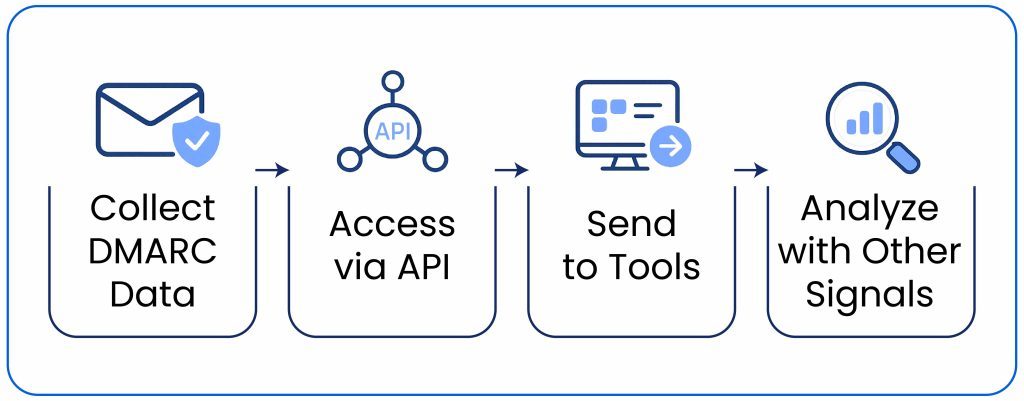
Step 1: Identify the DMARC data you need
The first step is defining what information is most relevant to your security and operational goals. This often includes authentication results such as SPF and DKIM alignment, sending source details like IP addresses and domains, and policy enforcement data.
By identifying the right data points early, organizations can avoid collecting unnecessary information and focus on insights that directly support threat detection and monitoring.
Step 2: Access reporting data through the platform API
Once requirements are clear, organizations retrieve DMARC monitoring data through the platform’s API or export capabilities. Most DMARC solutions provide access to parsed aggregate reports, allowing teams to work with structured data instead of raw XML files.
This step usually involves configuring API access, authentication, and endpoints to ensure data can be securely and reliably retrieved.
Step 3: Send the data to monitoring or analytics systems
After retrieving the data, the next step is forwarding it to the systems where it will be analyzed. This can include SIEM platforms, internal dashboards, or custom analytics pipelines.
Organizations often use data pipelines, connectors, or middleware to keep DMARC data continuously updated and available alongside other security signals.
Step 4: Correlate DMARC insights with other security signals
The final step is combining DMARC data with other sources of security telemetry. This may include phishing alerts, domain monitoring tools, or incident response systems.
By correlating these signals, security teams can gain deeper context around authentication failures and spoofing attempts, making it easier to detect patterns, investigate incidents, and support more effective investigation and response.
Essential Integrations for DMARC Solutions
To get the most value from DMARC monitoring, organizations typically connect their DMARC platform with other core systems in their security and infrastructure stack. These integrations ensure that authentication data is not isolated but contributes to broader visibility, analysis, and decision-making processes.
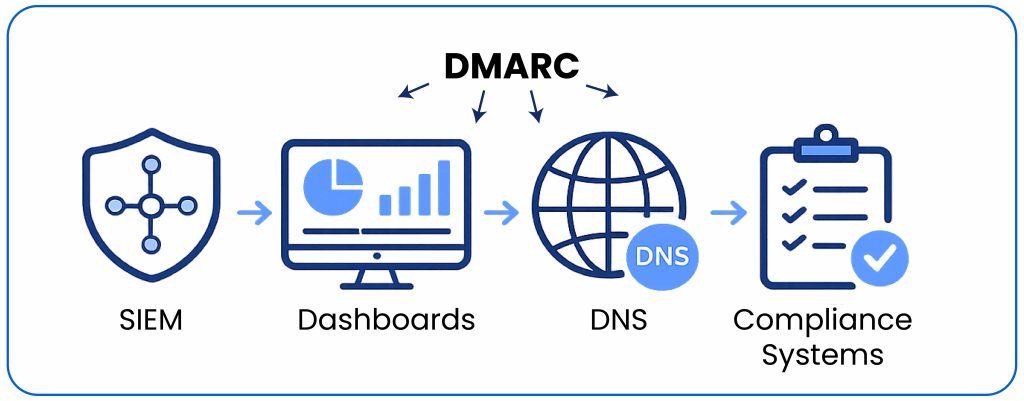
SIEM platforms
Security Information and Event Management (SIEM) platforms are one of the most common integration points for DMARC data. By feeding authentication results and spoofing attempts into a SIEM, organizations can analyze email-related threats alongside other security events.
This allows teams to detect patterns, contribute to alerting within connected systems, and investigate incidents more efficiently, especially when DMARC data is correlated with logs from endpoints, networks, or identity systems.
Security monitoring and analytics platforms
Many organizations integrate DMARC data into internal monitoring dashboards or analytics tools. These platforms help visualize trends such as authentication pass rates, failure spikes, or changes in sending behavior.
By incorporating DMARC insights into broader analytics environments, teams can better understand how email authentication impacts overall security posture and operational performance.
DNS infrastructure platforms
DNS providers play a critical role in managing DMARC, SPF, and DKIM records. Integrating DMARC monitoring with DNS infrastructure helps ensure that authentication policies are correctly configured and consistently applied across domains.
This connection also supports faster updates and better coordination between monitoring insights and DNS-level changes, reducing the risk of misconfigurations.
Governance and compliance reporting systems
Organizations often include DMARC monitoring data in governance and compliance workflows. Authentication results and policy enforcement data can support reporting requirements related to email security standards and regulatory frameworks.
By integrating DMARC data into compliance systems, teams can generate reports, demonstrate policy enforcement, and maintain better documentation of their email authentication practices.

Best Practices for API Integration with DMARC
To ensure DMARC API integrations deliver accurate and actionable insights, organizations should follow a set of practical best practices. These help maintain data quality, improve visibility, and ensure integrations remain secure and reliable over time.
Work with normalized reporting data
Parsed DMARC aggregate reports are significantly easier to work with than raw XML files. Normalized data allows teams to quickly analyze authentication results, identify patterns, and integrate insights into other systems without complex preprocessing.
Using structured data also reduces the risk of errors and improves consistency across reporting and analytics workflows.
Monitor authentication across all sending sources
Organizations often use multiple email services, including marketing platforms, transactional email providers, and internal systems. It is important to track authentication performance across all of these sources.
Monitoring all legitimate senders helps prevent gaps in visibility and reduces the likelihood of authentication failures caused by misconfigurations or overlooked services.
Maintain secure access to integration endpoints
API integrations involve transferring sensitive monitoring data between systems. Securing access to API endpoints is essential to prevent unauthorized access or data exposure.
This includes using strong authentication methods, managing API keys carefully, and ensuring that data transfers follow security best practices.
Review integrations regularly
Email infrastructure evolves as organizations adopt new tools or change sending providers. As a result, DMARC integrations should be reviewed regularly to ensure they remain accurate and aligned with current systems.
Periodic reviews help identify gaps, outdated configurations, or missing data sources, ensuring that monitoring continues to provide a complete and reliable view of authentication activity.
How EasyDMARC Supports Security Integrations
EasyDMARC is designed to help organizations integrate DMARC monitoring into their broader security and infrastructure environments. By supporting connections with enterprise systems and providing structured reporting data, the platform enables teams to treat email authentication as part of their overall security operations rather than a standalone function.
Integration with enterprise infrastructure
EasyDMARC integrates with key components of enterprise infrastructure, including DNS providers, email services, and security monitoring tools. This allows organizations to align authentication data with existing workflows and ensure that insights from DMARC monitoring are accessible across teams.
By connecting with these systems, organizations can reduce manual effort, improve coordination between teams, and maintain consistent visibility into email authentication performance through flexible DMARC integrations.
Visibility across multiple domains and senders
Managing email authentication across multiple domains and sending services can become complex, especially for large organizations. EasyDMARC helps centralize visibility by providing a unified view of authentication activity across all domains.
This is particularly important for organizations using multiple third-party senders, as it allows teams to track performance, identify misconfigurations, and maintain control over their entire email ecosystem, especially in environments that require DMARC for enterprise-level scalability.
Reporting for governance and compliance
EasyDMARC supports organizations that need structured reporting for governance and compliance purposes. DMARC monitoring data can be used to demonstrate policy enforcement, track authentication performance, and support internal or external audits.
This makes it easier for organizations to align email authentication practices with broader compliance programs, particularly when working toward DMARC service with compliance readiness requirements.
Making DMARC Monitoring Part of Your Security Operations
Integrating DMARC monitoring data into your security stack allows organizations to move from isolated visibility to coordinated threat detection. Instead of reviewing authentication reports separately, teams can incorporate DMARC insights into their existing monitoring workflows, alongside logs, alerts, and other security signals.
This integration improves visibility into domain spoofing attempts, authentication failures, and sending behavior across all domains. It also enables faster detection of anomalies by correlating DMARC data with other indicators such as phishing alerts or incident reports.
By making DMARC monitoring part of day-to-day security operations, organizations can treat email authentication as a monitored and enforced layer within their security strategy. This approach not only strengthens protection against spoofing and impersonation but also ensures that authentication performance is continuously monitored, analyzed, and improved over time.
FAQ
A DMARC API integration allows organizations to access DMARC monitoring data programmatically through an API. Instead of manually reviewing reports, teams can retrieve structured data and send it to other systems like SIEM platforms, dashboards, or analytics tools. This makes it easier to automate monitoring, analyze authentication results, and incorporate DMARC insights into broader security workflows.
DMARC APIs provide structured reporting data that can be forwarded to SIEM platforms. Once integrated, authentication failures, spoofing attempts, and sending activity appear alongside other security events. This allows teams to correlate DMARC insights with logs from different systems, helping detect patterns, alert, and investigate potential threats more efficiently.
Through a DMARC API, organizations can access parsed aggregate report data, including SPF and DKIM authentication results, sending IP addresses, domains, and policy enforcement outcomes. This data provides visibility into who is sending emails on behalf of a domain and whether those messages pass authentication checks.
Organizations integrate DMARC monitoring with security tools to improve visibility and detection of domain abuse. When DMARC data is combined with other security signals, teams can identify spoofing attempts faster, understand authentication trends, and respond to threats more effectively as part of a unified security strategy.
The most important integrations typically include SIEM platforms, security monitoring and analytics tools, DNS infrastructure providers, and governance or compliance systems. These integrations help ensure that DMARC data contributes to threat detection, infrastructure management, and reporting workflows across the organization.
EasyDMARC supports enterprise security monitoring by providing structured DMARC reporting data and enabling integration with key systems such as DNS platforms, email services, and security tools. This allows organizations to monitor authentication activity across multiple domains, detect anomalies, and incorporate DMARC insights into their overall security operations.

 We’re glad you joined EasyDMARC newsletter! Get ready for valuable email security knowledge every week.
 You’re already subscribed to EasyDMARC newsletter. Continue learning more about email security with us