




If your domain relies on multiple email services, your SPF record can quickly become too complex to manage. Each additional sender often adds nested include mechanisms, and before long, you risk hitting SPF’s strict DNS lookup limit. Once that happens, SPF validation can start failing, leading to delivery issues that are difficult to diagnose.
That’s where the best SPF flattening tools come in. These tools simplify SPF records by resolving nested lookups into a more manageable format, helping domains stay within limits and support consistent SPF validation. Whether you’re managing a growing infrastructure or multiple third-party senders, flattening can help reduce lookup failures that can break SPF validation.
What SPF Flattening Is and Why It Matters
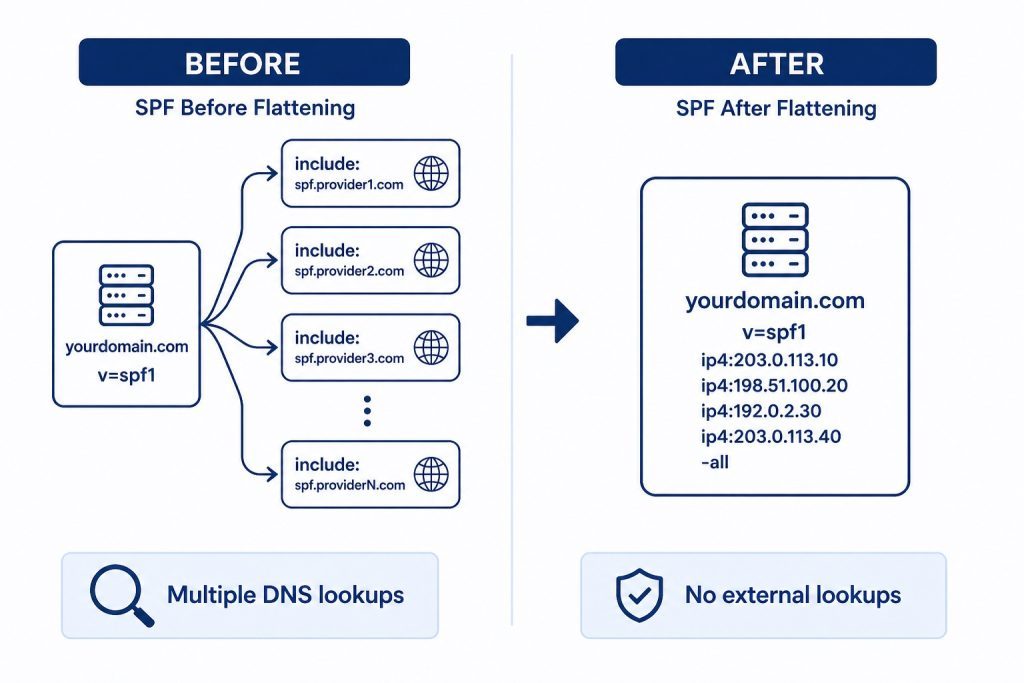
SPF flattening is the process of resolving nested include mechanisms within an SPF record into direct IP address entries or simplified structures. Instead of relying on multiple external lookups, a flattened record brings everything into a single, more controlled format. This helps reduce complexity and keeps SPF evaluation within allowed limits, especially for domains that depend on several email service providers.
What is the SPF 10 lookup limit?
SPF has a strict limit of 10 DNS lookups during record evaluation. Each include, a, mx, or redirect mechanism counts toward this total. When multiple email platforms are involved, these lookups can stack quickly, making it easy to exceed the limit without realizing it. Once the threshold is crossed, SPF checks may stop prematurely, leading to incomplete or failed SPF validation.
What happens when SPF lookup limits are exceeded?
When the lookup limit is exceeded, SPF returns a “permerror”, meaning the receiving server cannot properly validate the sender’s SPF record. This can result in authentication failures, which may cause emails to be flagged, rejected, or handled unpredictably by recipient systems. Using an SPF checker can help identify these issues early and confirm whether your SPF record is within acceptable limits.

Best SPF Flattening Tools
Not all SPF flattening tools work the same way. Some offer fully managed services that continuously update your SPF records, while others generate flattened records that you maintain yourself. The right approach depends on how complex your email infrastructure is and how much ongoing maintenance your team can support.
EasyDMARC’s EasySPF
EasySPF is designed to help organizations manage complex SPF records at scale, without exceeding lookup limits. It works by automatically resolving nested include mechanisms and maintaining a simplified SPF structure that remains within lookup limits as your sending infrastructure evolves.
Because many email providers update their IP ranges over time, EasySPF continuously monitors and updates flattened records to reduce the risk of outdated entries. In addition to flattening, it connects SPF data with DMARC insights, allowing administrators to see which included sources are actively sending email and which are no longer in use. This is especially important for domains where SPF has been managed by multiple teams over time, as unused or outdated include mechanisms often remain in place without visibility. This makes EasySPF particularly useful for maintaining a clean, accurate SPF record while supporting ongoing authentication oversight.
spFlat / spFlat!
spFlat is a lightweight SPF flattening tool that generates simplified SPF records by resolving nested includes into direct entries. It is typically used as a one-time or scheduled solution, giving teams more control over how their SPF record is structured.
This approach can work well for smaller setups, but it requires regular manual updates to ensure that IP ranges remain accurate as providers change their infrastructure.
Uptimo SPF Engine
Uptimo SPF Engine offers automated SPF flattening with periodic regeneration of SPF records. It continuously recalculates flattened records to reflect changes in upstream providers, helping maintain accuracy over time.
This type of solution reduces manual effort while still allowing organizations to keep SPF records within lookup limits. However, like other automated tools, it introduces some dependency on the service for ongoing updates and maintenance.
SPF Flattening Best Practices
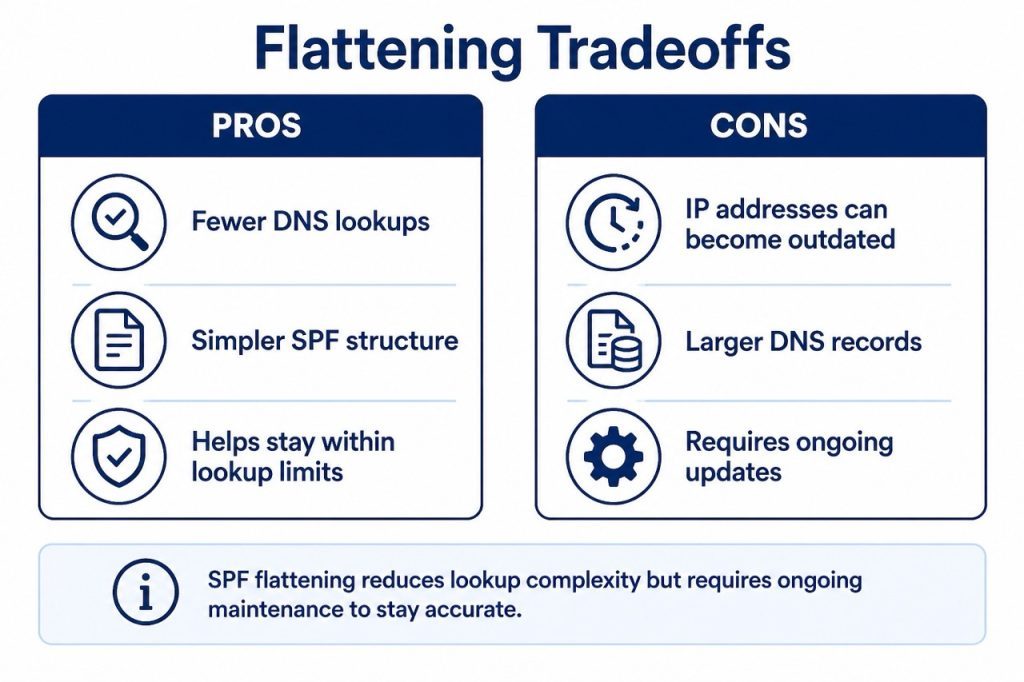
SPF flattening can help solve lookup limit issues, but it needs to be implemented carefully. Poorly managed flattening can lead to oversized records or outdated IP entries, which may create new deliverability risks instead of solving existing ones.
Keep SPF within lookup limits
The primary goal of flattening is to ensure your SPF record stays within the 10 DNS lookup limit. Even after flattening, it’s important to validate the final structure and confirm that no additional mechanisms push the record over the threshold.
Monitor DNS record size
Flattened SPF records often include many IP addresses, which can increase the overall DNS response size. If the record becomes too large, it may exceed DNS limits and fail to resolve properly. Keeping the record concise and well-structured helps avoid these issues.
Review flattened records regularly
Email providers frequently update their infrastructure, which means IP ranges can change over time. If flattened records are not updated, they may become outdated and cause authentication gaps. Understanding how to avoid SPF flattening can help teams recognize when flattening should be reconsidered or replaced with alternative approaches.

When SPF Flattening Becomes Necessary
SPF flattening becomes particularly useful when a domain depends on multiple third-party email services and the SPF record grows beyond manageable limits. Marketing platforms, transactional email providers, CRMs, and internal mail servers can all contribute additional include mechanisms, making it difficult to stay within the lookup threshold.
In these cases, flattening helps simplify the structure and maintain SPF reliability without requiring constant manual adjustments. For organizations operating at scale, managing SPF for large domains often requires a more structured approach to handle complex infrastructures and lookup limitations.
Choosing the Best SPF Flattening Service
Choosing the best SPF flattening service comes down to how well it balances automation, control, and long-term maintainability. While flattening can solve immediate lookup issues, the right tool should also help you manage ongoing changes without introducing new risks.
One of the most important factors is automation and update frequency. Email providers regularly update their IP ranges, so a reliable service should automatically refresh flattened records to prevent them from becoming outdated. This reduces manual effort and lowers the risk of authentication gaps. Some platforms also extend beyond flattening by connecting SPF data with DMARC insights, giving teams visibility into which included sources are actively sending email and which may no longer be needed.
Maintenance requirements also play a key role. Some tools offer fully managed solutions with continuous updates, while others rely on one-time or scheduled flattening that requires hands-on oversight. The right choice depends on your team’s capacity and how dynamic your sending infrastructure is.
It’s also important to consider DNS compatibility. The service should integrate smoothly with your DNS provider and support your domain’s configuration, including TTL settings and propagation expectations.
Finally, record size management should not be overlooked. Effective flattening keeps SPF within lookup limits without creating oversized DNS records that may fail to resolve. The best SPF flattening tools strike a balance between reducing complexity and keeping records efficient, making SPF easier to manage as your email ecosystem grows.

FAQ
SPF flattening is the process of simplifying an SPF record by replacing nested include mechanisms with direct IP address entries or managed records. This reduces the number of DNS lookups required during SPF checks. It is commonly used when domains rely on multiple email providers and risk exceeding SPF limits. Flattening can help maintain proper authentication, but it must be managed carefully to ensure records stay accurate as sending infrastructures evolve over time.
The SPF 10 DNS lookup limit exists to protect receiving mail servers from excessive DNS queries that could slow down or overload systems. Each SPF check requires resolving multiple mechanisms, and without a limit, complex records could create performance and security issues. By enforcing a cap, the SPF specification ensures predictable processing times. However, this also means domains using many email services must carefully structure their SPF records to avoid exceeding the limit.
SPF flattening tools can indirectly support deliverability by preventing SPF failures caused by exceeding lookup limits. When SPF checks fail, emails may be flagged or rejected by receiving servers. By keeping SPF records within limits, flattening helps ensure consistent authentication. However, deliverability also depends on other factors like DKIM, DMARC, and sender reputation. Flattening alone is not a complete solution but can help maintain a stable authentication setup.
Flattened SPF records should be reviewed and updated regularly because email providers frequently change their IP ranges. If records become outdated, legitimate emails may fail authentication. For manual setups, monthly reviews or updates after infrastructure changes are recommended. Automated or hosted flattening services can handle updates continuously, reducing the risk of stale data. Regardless of the method, ongoing monitoring is essential to ensure SPF records remain accurate and effective.
SPF flattening should be avoided when SPF records can be simplified through better structure, such as reducing unnecessary includes or separating services across subdomains. Flattening can introduce risks if not maintained properly, especially when IP ranges change. It may also lead to large DNS records that exceed size limits. If a domain’s email setup is relatively simple or manageable, alternative approaches can be more reliable and require less ongoing maintenance.

 We’re glad you joined EasyDMARC newsletter! Get ready for valuable email security knowledge every week.
 You’re already subscribed to EasyDMARC newsletter. Continue learning more about email security with us


