
Managing email authentication becomes more complex as organizations expand their domain and subdomain portfolios. Marketing platforms, transactional email services, regional domains, and third-party vendors rely on separate subdomains to send email on your behalf. Without a structured approach, this can lead to inconsistent policies, limited visibility, and increased risk of domain spoofing.
To manage DMARC across domains and subdomains effectively, organizations must understand how DMARC inheritance works, how root domain policies apply to subdomains by default, and how to centralize reporting across a growing ecosystem of sending domains. This guide explores why subdomain DMARC management matters, common challenges large organizations face, and the best solutions for implementing DMARC at scale while maintaining control and visibility across all subdomains.
Why Subdomain DMARC Management Matters
Subdomains are often used to separate email use cases such as marketing, billing, notifications, and customer support. While this segmentation improves operational flexibility, it also increases the potential attack surface for phishing and impersonation if DMARC enforcement isn’t applied consistently.
By default, DMARC policies configured at the root domain automatically apply to all subdomains. This inheritance simplifies deployment and ensures consistent protection without requiring separate configurations for each subdomain. However, administrators can override this behavior by explicitly defining a different subdomain policy using the sp= tag or by adding distinct DMARC records on specific subdomains.
Even though subdomains are protected under the root domain policy by default, organizations still benefit from maintaining visibility into how those subdomains are used to send email. This helps confirm that authentication is functioning as expected, detect unauthorized sources, and prevent potential brand abuse.
For enterprises managing large domain portfolios, centralized monitoring and clearly defined DMARC policies streamline oversight, helping maintain strong email security without adding unnecessary administrative burden.
How DMARC Works Across Domains and Subdomains
DMARC policies are published as DNS records and typically apply at the organizational (root) domain level. By default, subdomains inherit the DMARC policy of the parent domain. In most deployments, organizations configure DMARC once at the root domain and that policy automatically applies to all subdomains unless a separate DMARC record is published.
DMARC provides a dedicated mechanism, the sp (subdomain policy) tag, to define how DMARC should be enforced for all subdomains under a root domain. This allows organizations to apply a stricter or more relaxed policy to subdomains without changing the root domain’s enforcement level. In more advanced setups, individual subdomains can publish their own DMARC records, which override inherited policies entirely.
Understanding how inheritance works, when to use the sp tag, and when separate subdomain records are actually necessary is important when scaling DMARC across large domain portfolios.
Common Challenges When Managing DMARC for Multiple Subdomains
Managing DMARC across multiple subdomains introduces operational and technical challenges that don’t typically appear in single-domain environments. As the number of subdomains grows, so does the complexity of maintaining consistent authentication, visibility, and enforcement.
Some of the most common challenges organizations face include:
- Lack of centralized visibility: When subdomains don’t have their own DMARC record, their reports are sent to the reporting addresses defined in the root domain’s policy. However, DMARC XML reports don’t provide clear segmentation of subdomain activity, making it difficult to distinguish which sources are associated with which subdomains. Without centralized aggregation and analysis, teams may struggle to accurately assess authentication health or identify abuse patterns across all subdomains.
- Inconsistent policy enforcement: Different subdomains often serve different purposes and are managed by different teams or vendors. This can lead to a mix of inherited policies, overridden records, or missing DMARC configurations, resulting in uneven protection levels.
- Complex SPF and DKIM alignment: Subdomains frequently rely on multiple third-party senders. Ensuring each sender is properly aligned with SPF and DKIM becomes increasingly difficult at scale, especially when SPF lookup limits are exceeded or DKIM keys are inconsistently deployed.
- Unclear subdomain ownership: In large organizations, it’s common for subdomains to be created over time without clear documentation. When ownership and purpose are unknown, enforcing DMARC policies safely becomes risky and often leads to delayed enforcement.
- High report volume and noise: Organizations with many active subdomains may receive millions of DMARC aggregate reports daily. Without filtering, grouping, and intelligent analysis, important authentication issues can easily be missed.
- Risk of breaking legitimate email flows: Moving subdomains from monitoring to quarantine or rejection without proper validation can disrupt critical business communications. This risk often causes teams to delay enforcement indefinitely.
These challenges highlight why manual DMARC management does not scale well in multi-subdomain environments and why structured processes and specialized tools are essential.

Key Considerations for DMARC and Subdomains
Keep inheritance as the default model. Frame explicit subdomain policies and overrides as exceptions used when a subdomain has unique sending requirements, is managed by a third party, or requires a different enforcement timeline.
Although DMARC policies are typically configured at the root domain and inherited by subdomains, organizations still need visibility into how those subdomains are used for email sending. Organizations need to account for differences in email usage, ownership, and risk levels across their subdomain ecosystem. The following considerations help ensure DMARC is implemented in a scalable and controlled way.
Inheritance vs. Explicit Subdomain Policies
By default, subdomains inherit the DMARC policy of the root domain. This simplifies initial deployment but may not be appropriate for subdomains that rely on different email service providers or serve distinct business functions. In these cases, publishing an explicit DMARC record at the subdomain level allows organizations to override inherited policies and apply more tailored enforcement.
Using the DMARC SP Tag Strategically
The DMARC sp tag defines a policy specifically for subdomains and applies when no explicit subdomain record exists. It is commonly used to enforce a baseline level of protection across all subdomains while keeping the root domain policy unchanged. This approach is especially useful in large environments where creating individual DMARC records for every subdomain would be impractical.
Managing Third-Party Senders by Subdomain
Many subdomains are used by external vendors for marketing, transactional messaging, or customer engagement. Each sender must be properly authenticated and aligned with SPF and DKIM for DMARC to pass. Mapping third-party providers to specific subdomains helps reduce alignment errors and limits the blast radius if a provider is misconfigured.
Scaling Policy Enforcement Gradually
Applying quarantine or reject policies across all subdomains without validation can disrupt legitimate email flows. A phased enforcement strategy allows teams to monitor authentication results, resolve alignment issues, and progressively increase enforcement levels without impacting deliverability.
Centralizing Reporting and Accountability
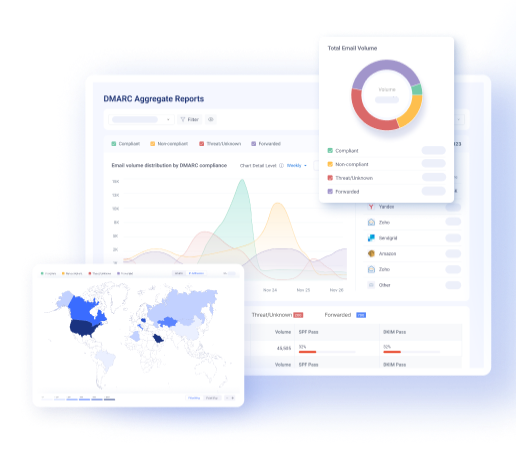
Without centralized reporting, visibility into subdomain authentication quickly breaks down. Organizations should ensure DMARC reports from all subdomains are collected, normalized, and analyzed in a single view. Clear ownership of subdomains and reporting responsibilities is also critical to maintaining long-term policy effectiveness.
Top Solutions for Monitoring DMARC Across Domains and Subdomains
For organizations with large domain portfolios, managing DMARC manually across dozens or hundreds of subdomains quickly becomes unsustainable. Purpose-built DMARC platforms help centralize policy management, automate reporting, and reduce the operational risk of enforcing DMARC at scale.
The following solutions are commonly used to manage DMARC for multiple subdomains, with varying levels of depth, automation, and enterprise readiness.
EasyDMARC
EasyDMARC is a DMARC management platform designed for organizations with complex domain and subdomain environments. It provides centralized visibility across root domains and subdomains, allowing teams to monitor authentication results, apply policies consistently, and safely progress toward enforcement.
The platform is good at multi-subdomain scenarios where different teams, regions, or vendors manage email sending. EasyDMARC simplifies this complexity by aggregating reports, guiding SPF and DKIM alignment, and supporting structured enforcement workflows.
The tool also automatically discovers subdomains through DMARC reporting, helping organizations identify all sending sources without manually configuring DMARC records for each subdomain.
EasyDMARC’s focus on scalability, visibility, and expert-led implementation makes it well-suited for enterprises managing large and dynamic domain portfolios.
Key Features:
- Centralized DMARC management across domains and subdomains
- Clear visibility into subdomain-level authentication results
- Guided policy progression from monitoring to enforcement
- Support for subdomain policies and DMARC sp tag strategies
- Advanced SPF and DKIM monitoring to prevent alignment issues
- Scalable reporting that handles high report volumes efficiently
- Expert support for complex, multi-vendor sending environments
Best for: Enterprises, SaaS companies, and organizations with many active subdomains that need centralized control, scalable reporting, and guided DMARC enforcement.
DMARCLY

DMARCLY is a user-friendly DMARC monitoring and policy management platform designed for small to mid-sized organizations. However, as subdomain counts increase, manual DMARC management becomes error-prone, time-consuming, and difficult to scale. It offers guided setup and clear reporting, making it easier to understand authentication results across domains and subdomains without deep technical expertise.
Key Features:
- DMARC monitoring and visualization
- Support for DMARC subdomain policies (sp tag)
- Guided policy configuration
- Aggregate report parsing and dashboards
Best for: Small and mid-sized teams that need a straightforward way to monitor DMARC across a limited number of domains and subdomains.
DMARCPal
DMARCPal focuses primarily on DMARC reporting and visibility rather than full policy lifecycle management. It helps organizations understand how email is being authenticated across domains and subdomains by converting raw DMARC reports into readable insights.
Key Features:
- DMARC aggregate report aggregation
- Subdomain-level reporting visibility
- Simple dashboards for authentication results
- Alerting for DMARC failures
Best for: Organizations that already manage DMARC records manually and need better visibility into subdomain authentication results.
GoDMARC
GoDMARC provides basic DMARC monitoring and reporting capabilities with an emphasis on ease of use. It helps organizations track authentication performance across domains and subdomains, though it offers limited automation for large-scale environments.
Key Features:
- DMARC monitoring for domains and subdomains
- Aggregate report visualization
- Policy status tracking
- Basic alerting features
Best for: Teams looking for entry-level DMARC monitoring across a small domain or subdomain footprint.
Manual vs. Managed DMARC: What Works Best for Multi-Subdomain Environments
Managing DMARC manually can work for organizations with a small number of domains and predictable sending patterns. However, as subdomain counts increase, manual DMARC management quickly becomes error-prone, time-consuming, and difficult to scale.
In manual setups, teams are responsible for maintaining DNS records, monitoring raw DMARC reports, validating SPF and DKIM alignment, and coordinating changes across multiple stakeholders. This often leads to delayed enforcement, missed authentication failures, and limited visibility into subdomain-level risks.
Managed DMARC solutions are designed to address these challenges by centralizing policy management, automating report processing, and providing clear guidance for enforcement.
In multi-domain environments, managed platforms reduce operational overhead by centralizing reporting, discovering sending sources, and providing visibility across domains and subdomains in a single interface. They also help organizations safely move from monitoring to enforcement without disrupting legitimate email flows.
For organizations with complex domain portfolios, managed DMARC approaches provide the scalability, visibility, and control that manual processes struggle to maintain, especially when using DMARC tools for managing multiple clients.
Implementing DMARC at Scale for Multiple Domains
Implementing DMARC across multiple domains typically begins with a root domain DMARC policy and centralized reporting. Attempting to enforce policies everywhere at once increases the risk of misconfiguration and email disruption.
Start by creating a complete inventory of all domains and subdomains that send email, along with the services and teams responsible for each. This visibility is essential for determining which subdomains can safely inherit policies and which require custom configurations.
Next, apply DMARC in monitoring mode to validate SPF and DKIM alignment across sending sources. High-risk or high-volume subdomains should be reviewed individually before enforcement. Gradually progress policies toward quarantine or reject once authentication results are stable and understood.
At scale, automation and centralized management become critical. Platforms that support bulk updates, subdomain-level visibility, and guided enforcement significantly reduce the effort required to maintain consistent DMARC protection across large domain portfolios.

DMARC Reporting for Subdomains: What to Watch
DMARC reporting is essential for understanding how email authentication performs across subdomains. Each subdomain generates its own authentication results, and without proper aggregation, important issues can go unnoticed.
When reviewing DMARC reports for subdomains, organizations should focus on authentication pass and fail rates by subdomain, sending source, and policy outcome. Sudden spikes in failures may indicate misconfigured SPF or DKIM records, newly introduced third-party senders, or attempted abuse of a subdomain.
High-volume environments also need to watch for report overload. Millions of aggregate reports can obscure real problems if they are not normalized and filtered effectively. Centralized reporting tools help surface meaningful trends, identify risky subdomains, and confirm when it is safe to move specific subdomains toward stricter DMARC enforcement.
Take Control of Subdomain Email Security
As organizations scale their domain and subdomain environments, unmanaged subdomains quickly become a security risk. Marketing platforms, applications, and third-party services often rely on separate subdomains, and without consistent DMARC policies, these can be exploited for spoofing and phishing.
To manage DMARC across domains and subdomains effectively, organizations need clear visibility, consistent enforcement, and centralized reporting. Understanding DMARC inheritance, using the sp tag appropriately, and applying subdomain-specific policies where needed allows teams to secure complex email ecosystems without disrupting legitimate email delivery.
Frequently Asked Questions
DMARC is published at the domain level, and subdomains inherit the root domain’s policy by default. This means the same DMARC rules apply to subdomains unless a separate policy is defined using the sp tag or a dedicated DMARC record is created for a specific subdomain.
The sp tag defines a DMARC policy specifically for subdomains. It applies when a subdomain does not have its own DMARC record and allows organizations to enforce different policies for subdomains than for the root domain, such as stricter enforcement or extended monitoring.
Yes. If no subdomain-specific DMARC record exists, subdomains automatically inherit the root domain’s DMARC policy. This inheritance can be modified using the sp tag or overridden entirely by publishing a DMARC record at the subdomain level.
A separate DMARC record should be created when a subdomain uses unique email providers, has different risk levels, or requires a different enforcement timeline than the root domain. This is common for externally managed or high-volume sending subdomains.
The main challenges include limited visibility across subdomains, inconsistent policy enforcement, complex SPF and DKIM alignment with third-party senders, and handling large volumes of DMARC reports without centralized analysis.
Organizations can centralize DMARC reporting by routing aggregate reports from all domains and subdomains to a single reporting destination and using platforms that aggregate, normalize, and visualize this data in one dashboard.
The most effective approach is a phased rollout that starts with monitoring, validates SPF and DKIM alignment per subdomain, and gradually moves toward enforcement. Using centralized tools or DMARC managed services helps automate reporting, policy management, and enforcement at scale.

 We’re glad you joined EasyDMARC newsletter! Get ready for valuable email security knowledge every week.
 You’re already subscribed to EasyDMARC newsletter. Continue learning more about email security with us


