


Many organizations assume that publishing a DMARC record means they are ready to enforce it. In reality, having a record in DNS and having a configuration that can safely support enforcement are two very different things. Before moving toward stricter policies, every sending source, authentication mechanism, and alignment path should be validated.
If you plan to test the domain for DMARC enforcement, the goal is not simply to confirm that a record exists. The real question is whether your email ecosystem can consistently pass DMARC evaluation without disrupting legitimate mail. This readiness audit checklist covers the technical and operational checks that should be completed before policy advancement begins.
What DMARC Readiness Actually Means
DMARC readiness means more than publishing a record with a monitoring policy. It requires correctly configured SPF, DKIM, and DMARC records, proper identifier alignment, complete visibility into sending sources, and stable authentication results across the domains that send mail on your behalf.
A domain is not considered ready for enforcement simply because it has a DMARC record set to p=none. Monitoring policies provide visibility into authentication activity, but they do not confirm that every legitimate mail stream is configured correctly. Gaps in SPF, DKIM, or alignment often remain hidden until enforcement begins and legitimate messages are affected.
When organizations test DMARC readiness, the objective is to verify that authentication is working consistently across all authorized senders and that DMARC pass rates remain stable over time. Platforms such as EasyDMARC help centralize this validation process by combining DNS checks, authentication analysis, and reporting data into a single operational view.

The Pre-Enforcement Audit: Six Things to Confirm
Before advancing your DMARC policy, confirm the following six areas across your entire email ecosystem.
| Audit Item | What to Confirm |
SPF record | Single valid record, under 10 DNS lookup limit, no duplicate records |
DKIM configuration | Configured for every sending source, 2048-bit keys where supported |
Identifier alignment | SPF Return-Path and/or DKIM d= both align with RFC5322.From domain |
Sender inventory | All active sending sources identified, documented, and authenticated |
DMARC pass rate | 98% or higher, stable across multiple reporting periods |
1. SPF Is Published, Valid, and Under the Lookup Limit
Every sending domain should have a single SPF record. Publishing multiple SPF records for the same domain results in a PermError under RFC 7208, causing SPF evaluation to fail. Large environments often accumulate duplicate records over time as new services are added without reviewing existing configurations.
SPF also has strict processing limits: a maximum of 10 DNS mechanism lookups and 2 void lookups. Exceeding either limit can trigger a PermError and prevent successful authentication.
For domains still under audit, ~all is usually the safer default, while -all may be considered once all legitimate sending sources are fully validated, though it provides no additional enforcement benefit when DMARC is in place.
Organizations approaching lookup limits often use the best SPF flattening tools to simplify SPF evaluation and reduce the risk of authentication failures.
2. DKIM Is Configured for Every Sending Source
DKIM should be configured wherever email originates, not only at the organizational domain level. Every third-party platform that sends mail on behalf of your organization should be reviewed for DKIM support and configured for proper alignment wherever possible.
When a sender is missing DKIM configuration, the gap typically appears in aggregate reports as an unauthenticated mail stream. Organizations should also verify key strength during the audit process. While 1024-bit keys still exist in some environments, 2048-bit DKIM keys are the recommended standard and should be used whenever supported. Solutions such as hosted DKIM for enterprises can help maintain consistent DKIM deployment across large sender inventories.
3. Identifier Alignment Is Confirmed, Not Assumed
SPF and DKIM passing individually does not guarantee a DMARC pass result. DMARC requires at least one authentication mechanism to pass in aligned form with the RFC5322.From the domain.
For SPF alignment, the Return-Path domain must align with the From domain. For DKIM alignment, the d= signing domain must align with the From domain. Misalignment is one of the most common causes of DMARC failures for third-party email platforms and should be actively validated rather than assumed to be working.
4. All Sending Sources Are Inventoried and Authorized
Unknown sending sources remain one of the most common reasons organizations struggle during DMARC enforcement projects. Marketing tools, departmental applications, legacy systems, and other shadow IT services often send mail without being formally documented.
These unauthorized or forgotten senders frequently appear as failures in DMARC aggregate reports. Before advancing policy, every legitimate sending source should be identified, reviewed, and properly authenticated. EasyDMARC helps surface these hidden streams through aggregate report analysis, making it easier to build a complete sender inventory.
5. DMARC Pass Rate Is Stable Before Policy Advancement
The DMARC pass rate represents the percentage of messages that successfully pass DMARC evaluation across all sending sources during a reporting period. A high pass rate demonstrates that authentication and alignment are functioning consistently throughout the environment.
Pass Rate | Status | Recommended Action |
Below 90% | Critical | Investigate authentication failures before any policy change |
90–97% | Needs remediation | Identify and fix alignment gaps, missing DKIM, or unauthorized senders |
98% or higher | Advancement-ready | Validate stability across multiple reporting cycles before advancing policy |
Organizations should avoid advancing policy based on a single successful reporting cycle. Instead, a DMARC pass rate of approximately 98% or higher should remain stable across multiple reporting periods before moving toward stricter enforcement. It’s also important to remember that DMARC aggregate reporting is periodic rather than real time, making trend analysis more valuable than isolated results.

How to Test Your Domain for DMARC
Once the audit criteria are defined, the next step is to validate them against your live environment. To test a domain for DMARC readiness, organizations need visibility into DNS records, authentication results, identifier alignment, sending source inventories, and reporting trends. Looking at a DMARC record in isolation rarely provides enough information to determine whether a domain is ready for enforcement.
EasyDMARC helps organizations test DMARC readiness by combining DNS validation, reporting analysis, and authentication monitoring in a single platform. Teams can use the DMARC checker to verify record syntax and configuration, review aggregate reports to identify unauthorized senders, and monitor authentication performance across domains and subdomains. This makes it easier to uncover hidden alignment issues, incomplete DKIM deployments, and SPF-related failures before policy advancement begins.
Readiness testing should also be part of a broader email authentication strategy. Organizations evaluating tools and governance processes can use the audit findings to help choose email authentication service provider solutions that support long-term visibility, policy management, and reporting requirements. Start by assessing your current authentication posture, identifying gaps, and validating that every authorized sender can consistently pass DMARC before moving toward enforcement.
Moving from Audit to Enforcement
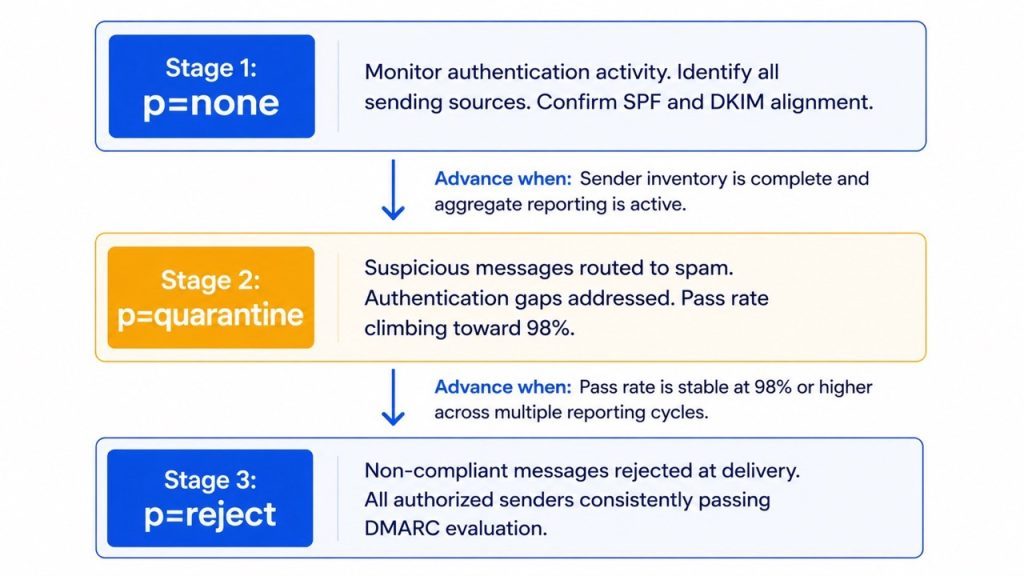
Once the audit is complete and authentication results remain stable across multiple reporting cycles, organizations can begin advancing their DMARC policy. The standard progression starts with p=none for visibility, moves to p=quarantine to increase protection against suspicious messages, and eventually reaches p=reject when unauthorized mail can be safely rejected by participating receivers. However, p=reject should not be viewed as a finish line. Enforcement is only effective when authentication remains accurate as sending environments evolve.
Policy advancement should be based on observed authentication performance rather than arbitrary timelines. A stable sender inventory, consistent alignment, and a strong DMARC pass rate are all indicators that the domain is ready to progress. If policy changes are introduced before these conditions are met, legitimate mail may be impacted alongside malicious traffic.
Organizations familiar with older DMARC implementations should also be aware of changes introduced in RFC 9989. The pct tag is no longer part of the standard, meaning phased enforcement is no longer managed through percentage-based policy application. Instead, the t=y testing mode can support policy testing before organizations move fully into enforcement. Because DMARC reporting remains aggregate and periodic rather than real-time, decisions should be based on reporting trends and sustained performance over time.
Whether you are refining an existing deployment or preparing for stricter enforcement, tools such as a DMARC record generator can help validate policy syntax. At the same time, broader DMARC service compliance readiness assessments provide additional assurance that technical controls and operational processes are aligned before advancing policy.
Maintaining Readiness After Enforcement
Reaching enforcement is not the end of the process. New marketing platforms, CRM integrations, ticketing systems, and third-party vendors are regularly introduced into email ecosystems, often without corresponding updates to SPF, DKIM, or DMARC configurations. DNS changes, expired DKIM keys, and vendor-side configuration updates can also create authentication failures that remain unnoticed until legitimate mail is affected.
Maintaining readiness requires continuous visibility into authentication performance, sender inventories, and policy coverage across all domains and subdomains. Solutions focused on enterprise DMARC monitoring help security and IT teams detect configuration drift, investigate new sending sources, and maintain governance as environments evolve. Organizations managing multiple domains should treat DMARC as an ongoing operational discipline rather than a one-time implementation project. Start a trial to gain the visibility and control needed to maintain a healthy authentication posture as your email infrastructure grows.

A DMARC Record Is the Starting Point, Not the Finish Line
Publishing a DMARC record is only the first step. True readiness comes from maintaining accurate authentication, strong alignment, complete sender visibility, and consistent performance over time.
If you want to test a domain for DMARC enforcement with confidence, focus on continuous validation rather than one-time configuration checks. Explore EasyDMARC to monitor readiness, strengthen governance, and support long-term email authentication success.
Frequently Asked Questions
A domain is ready for DMARC enforcement when all legitimate sending sources are properly authenticated, identifier alignment is working as expected, and authentication performance remains stable over multiple reporting cycles. Having a DMARC record with p=none is not enough on its own. Organizations should verify SPF and DKIM coverage, confirm that all authorized senders are accounted for, review aggregate reports for unknown sources, and maintain a DMARC pass rate of approximately 98% or higher before advancing toward quarantine or reject policies.
A good DMARC pass rate is generally considered to be 98% or higher across multiple reporting periods. More importantly, the pass rate should be stable and representative of all legitimate sending sources rather than the result of a single successful reporting cycle. A lower pass rate may indicate missing DKIM configuration, SPF issues, alignment failures, or unauthorized senders operating within the environment. Organizations should investigate the causes of failures before moving to stricter DMARC enforcement policies.
Yes. DMARC does not evaluate authentication results alone; it also evaluates alignment. SPF can pass while failing alignment if the Return-Path domain does not align with the RFC5322.From the domain. Similarly, DKIM can pass cryptographic validation while failing alignment if the d= signing domain does not align with the From domain. DMARC requires at least one authentication mechanism to pass in an aligned form. This is why alignment issues are among the most common causes of unexpected DMARC failures.
There is no universal timeline because readiness depends on the complexity of the email environment. Smaller organizations with a limited number of sending sources may progress within a few weeks, while large enterprises often require several months of monitoring, remediation, and validation. Policy advancement should be driven by stable authentication results, complete sender visibility, and sustained DMARC pass rates rather than fixed deadlines. Organizations should review multiple reporting cycles before deciding to move toward stricter enforcement.
 We’re glad you joined EasyDMARC newsletter! Get ready for valuable email security knowledge every week.
 You’re already subscribed to EasyDMARC newsletter. Continue learning more about email security with us


