

Managing SPF for large domains is no longer a simple DNS task. As organizations scale, they rely on dozens of email sending services across marketing, transactional, support, cloud platforms, and internal systems. Each new sender adds complexity to the SPF record, quickly pushing it toward the strict 10 DNS lookup limit enforced by the SPF specification. Once that limit is exceeded, SPF checks can fail outright, causing legitimate emails to bounce, land in spam, or trigger DMARC failures.
This is where manual SPF management starts to break down. Frequent sender changes, multiple domains and subdomains, and decentralized ownership make SPF updates slow, risky, and error-prone. A managed SPF solution for large domains is designed to solve these challenges by centralizing control, automating optimization, and preventing lookup limit errors before they impact deliverability. By using techniques such as SPF flattening and hosting services, large organizations can maintain reliable email authentication without constantly rewriting complex DNS records.
SPF Lookup Limits: The Problem Large Domains Can’t Ignore
For large organizations, SPF failures rarely happen because SPF is misunderstood. They happen because SPF simply wasn’t designed for modern email ecosystems. The moment your SPF record exceeds the 10 DNS lookup limit, receiving mail servers stop evaluating it and return a permanent error. When that happens, legitimate emails can fail authentication even though the sending services are valid.
This issue often surfaces as an SPF PermError, typically triggered by “too many DNS lookups.” Each “include, a, mx”, or “redirect” mechanism consumes part of the lookup budget, and large domains routinely exceed the limit without realizing it. Marketing platforms, CRMs, cloud email services, and third-party vendors all add their own includes, creating a fragile chain that breaks as soon as one more sender is added. You can use an SPF Lookup to see how quickly these records grow and where the limit is being exceeded.
What makes this especially dangerous is that SPF lookup failures don’t always generate clear warnings. Email may appear to send normally, while deliverability quietly degrades in the background. Understanding why this happens and how to fix “too many DNS lookups” errors is critical before SPF failures begin to impact business-critical email flows.
Why SPF Breaks in Modern Email Environments
SPF was created for a time when organizations sent email from a small, predictable set of servers. That model no longer exists. Large domains now rely on a constantly changing mix of marketing tools, transactional email services, CRMs, helpdesk platforms, cloud infrastructure, and third-party vendors, all of which need to be authorized in SPF.
Every new service typically adds one or more “include” statements to the SPF record. While each change may seem harmless on its own, the cumulative effect is a record that grows fragile and difficult to manage. One additional sender can push the record past the lookup limit, instantly breaking SPF authentication for the entire domain. In environments where multiple teams manage email independently, these changes often happen without centralized oversight.
The problem is amplified across multiple domains and subdomains. Large organizations and MSPs may manage hundreds of SPF records, each with different senders and update cycles. Without automation and visibility, SPF becomes reactive rather than controlled, increasing the risk of lookup limit failures, misconfigurations, and inconsistent email authentication across the organization.
The SPF 10-Lookup Rule (Explained Simply)
SPF includes a hard technical limit that many large domains run into faster than expected. During SPF evaluation, a receiving mail server is allowed to perform no more than 10 DNS lookups. If that limit is exceeded, SPF processing stops, and the check fails with a permanent error.
What counts toward the limit is often misunderstood. The following SPF mechanisms consume DNS lookups:
- include: statements referencing third-party senders
- a mechanisms that resolve hostnames to IPs
- mx mechanisms that evaluate mail exchangers
- ptr mechanisms (strongly discouraged)
- redirect= statements
Mechanisms that do not count toward the limit include:
- ip4: and ip6: entries
- all (for example, ~all or -all)
The challenge for large domains is that most modern email services require include: statements. Each includes one lookup, and some include triggering additional lookups behind the scenes. As a result, SPF records can exceed the 10-lookup limit long before they appear “complex” on the surface. This is why SPF failures often occur suddenly, and manual SPF management becomes unreliable at scale.

Common SPF Mistakes That Push You Over the Limit
Large domains rarely exceed the SPF lookup limit because of one big mistake. It usually happens through a series of small, well-intentioned changes that accumulate over time. Without centralized control, these issues are easy to miss until SPF authentication starts failing.
Common causes include:
- Too many “include” statements: Adding new email platforms without removing unused ones quickly consumes the lookup budget.
- Nested includes from third-party services: Some providers reference multiple other domains internally, multiplying DNS lookups without visibility.
- Using “a” and “mx” mechanisms unnecessarily: These mechanisms trigger additional DNS queries and are often added “just in case,” even when not required.
- Multiple SPF records per domain: Publishing more than one SPF record causes SPF to fail, regardless of lookup count.
- Outdated or abandoned senders: Legacy tools and former vendors remain in SPF long after they stop sending email.
- Uncoordinated updates across teams: Marketing, IT, and external vendors modifying SPF independently increases the risk of breaking changes.
These mistakes are especially costly in large environments, where SPF errors can impact multiple domains or subdomains at once. This is why many organizations move away from manual edits and adopt SPF flattening and hosting services that prevent lookup limit failures by design.
Managed SPF: A Smarter Way to Control SPF at Scale
Managed SPF replaces fragile, manual DNS edits with a centralized and automated approach built for growth. Instead of stacking “include” statements and reacting to failures after the fact, large organizations delegate SPF optimization to a system that continuously enforces policy and stays within the 10-lookup limit.
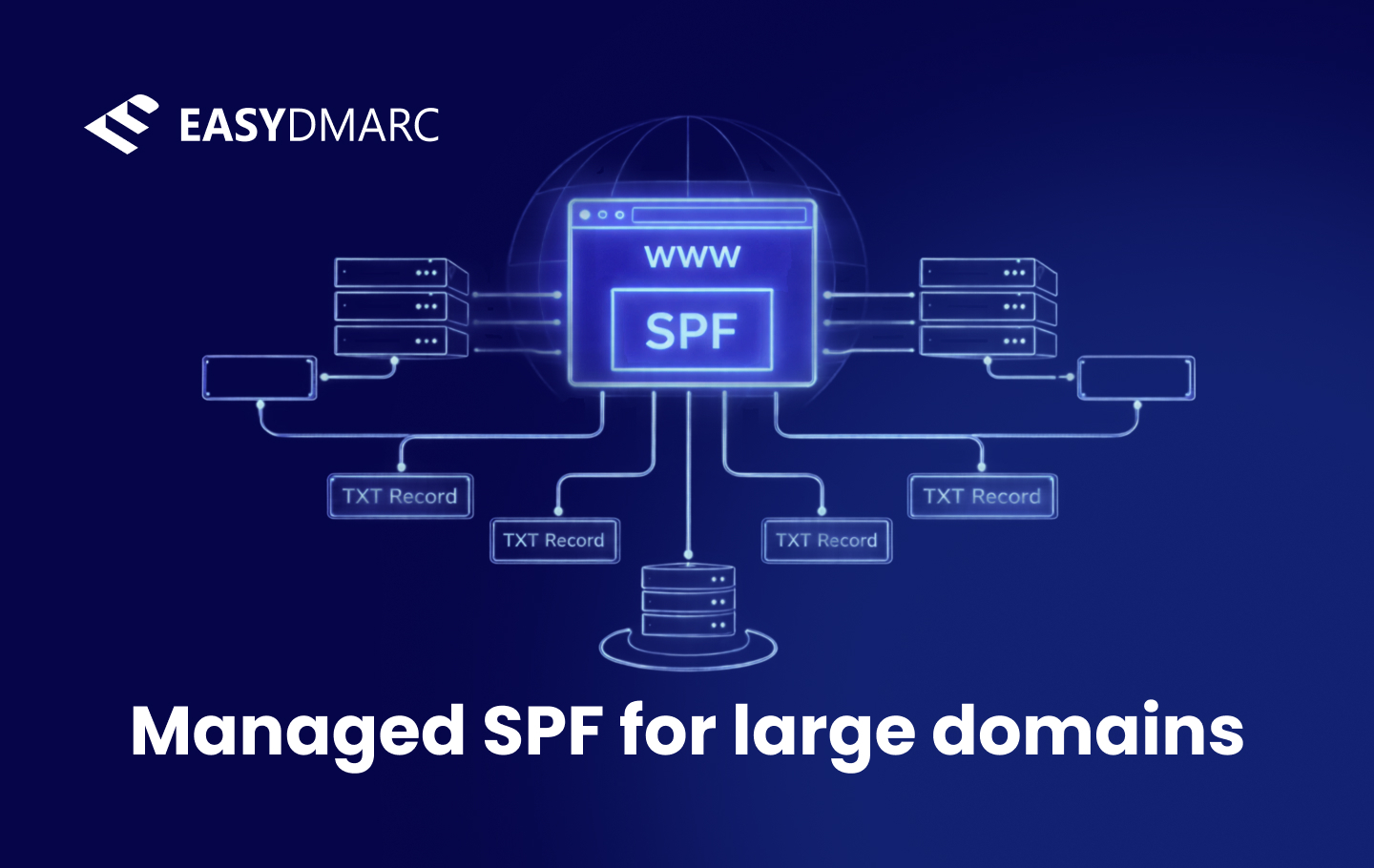
At its core, a managed SPF solution resolves and optimizes sender authorization behind the scenes. Domains publish a single, stable SPF reference, while the provider dynamically maintains the underlying logic. This makes SPF resilient to frequent sender changes, reduces human error, and prevents lookup limit failures before they affect deliverability.
EasyDMARC as a Managed SPF Provider
EasyDMARC offers an enterprise-grade managed SPF solution for large domains, purpose-built for organizations, MSPs, and high-scale email environments. It centralizes SPF management across domains and subdomains, automates optimization to prevent lookup limit overruns, and continuously validates changes to avoid SPF PermErrors.
EasySPF is included as part of this managed SPF capability, dynamically hosting and maintaining optimized SPF records without exposing complex include chains in DNS. This allows teams to add or remove sending services safely, maintain consistent authentication at scale, and integrate SPF management into a broader SPF, DKIM, and DMARC strategy without operational friction.
Key Features to Look for in a Managed SPF Solution
Not all managed SPF offerings are built for large or complex environments. When evaluating a managed SPF solution for large domains, certain capabilities are essential to ensure scalability, reliability, and long-term control.
Centralized SPF Management Across Domains
A single management interface should allow teams to control SPF records for all domains and subdomains from one place. This is critical for large organizations and MSPs managing multiple clients or business units, as it reduces manual DNS edits and minimizes configuration drift.
Automatic Handling of SPF Lookup Limits
The solution should proactively prevent SPF records from exceeding the 10 DNS lookup limit. This typically includes SPF flattening or dynamic hosting that resolves “includes” safely while preserving the intended authorization logic.
Automated Updates and Change Validation
Sending services frequently change their infrastructure. A managed SPF platform should automatically adapt to these changes, validate SPF records after every update, and prevent misconfigurations that could cause SPF PermErrors or delivery failures.
Monitoring, Alerts, and Error Prevention
Continuous monitoring is essential to detect SPF issues before they impact email flow. Look for alerting on lookup limit risks, invalid records, and unauthorized changes, along with rollback options to quickly recover from errors.
Integration With Broader Email Authentication
SPF should not be managed in isolation. A strong managed SPF solution integrates with DKIM and DMARC, providing unified visibility into authentication health and supporting consistent policy enforcement across large-scale email environments.

Managed SPF vs Manual SPF Management
For small environments, manual SPF management can work. For large domains, it quickly becomes fragile and difficult to maintain. Each new sending service requires DNS changes, careful lookup counting, and coordination across teams. One missed update or extra “include” can push the record past the 10-lookup limit and cause SPF to fail for the entire domain.
A managed approach removes this operational risk. Instead of editing SPF records directly, organizations use a managed SPF solution for large domains that centralizes control and automates optimization. Sender changes are handled through a controlled system, SPF records are continuously validated, and lookup limits are enforced automatically. This makes SPF predictable, auditable, and resilient, even as email infrastructure grows and changes over time.
How EasyDMARC Helps Large Domains Manage SPF at Scale
EasyDMARC is designed to support large, complex email environments where SPF changes are frequent and manual management is no longer sustainable. It provides centralized visibility and control over SPF records across domains and subdomains, reducing the risk of misconfigurations and lookup limit failures.
By automating SPF optimization and validation, EasyDMARC helps organizations stay within the 10 DNS lookup limit while preserving accurate sender authorization. Changes to sending services are reflected safely without requiring constant DNS edits, and potential issues are identified before they impact deliverability. Combined with monitoring and broader email authentication management, EasyDMARC enables large domains to maintain reliable SPF enforcement at scale while minimizing operational overhead.
Step-by-Step: Fixing an SPF Lookup Limit Issue
When an SPF record exceeds the 10 DNS lookup limit, email authentication can fail immediately and affect all outbound mail. The goal of remediation is not just to reduce lookups once, but to prevent the issue from returning as senders change over time. The steps below outline a safe, scalable approach.
Step 1: Confirm the lookup limit failure
Review mail logs, DMARC reports, or receiver feedback for SPF PermError or “too many DNS lookups” errors. This confirms that SPF evaluation is stopping before a result is returned.
Step 2: Audit the SPF record
Run an SPF check to:
- Count total DNS lookups, including nested include statements
- Identify which mechanisms are consuming the lookup budget
- Detect issues such as multiple SPF records or invalid syntax
Step 3: Inventory active sending sources
Document all legitimate senders across marketing, transactional, support, cloud services, and third parties. Remove obsolete or unused services that still appear in SPF.
Step 4: Reduce lookup-heavy mechanisms
Eliminate unnecessary a, mx, and redundant include mechanisms where possible. Avoid ptr entirely, as it is both lookup-heavy and discouraged.
Step 5: Apply managed SPF or SPF flattening
Move to SPF flattening and hosting services to resolve sender authorization without exceeding the lookup limit. A managed SPF approach ensures optimization is handled dynamically as senders change.
Step 6: Validate and monitor continuously
After changes are applied, revalidate the SPF record and monitor it over time. Continuous checks help prevent future lookup limit failures as new sending services are introduced.

Best Practices for SPF Management in Large Organizations
SPF stability in large environments depends on process, not one-time fixes. As domains grow and email infrastructure evolves, consistent practices are essential to avoid recurring lookup limit failures and authentication errors.
- Centralize ownership of SPF changes: Assign clear responsibility for SPF management to prevent uncoordinated updates from multiple teams or vendors.
- Continuously audit active sending sources: Regularly review which platforms are authorized to send email and remove inactive or legacy services from SPF.
- Avoid direct DNS edits whenever possible: Manual changes increase the risk of syntax errors and lookup limit overruns, especially in high-change environments.
- Plan for scale from the start: Large domains should assume sender growth and understand how to overcome SPF lookup limit issues early, rather than reacting to failures later.
- Monitor SPF health proactively: Ongoing validation and alerting help catch lookup limit risks and misconfigurations before they impact deliverability.
Following these practices helps large organizations maintain consistent SPF enforcement, reduce operational overhead, and prevent SPF issues from disrupting critical email workflows.
Take Control of SPF Before It Breaks Your Email Infrastructure
For large domains, SPF failures are rarely a one-time issue. As sending services grow and change, manual SPF management becomes increasingly fragile, making lookup limit errors and authentication failures inevitable. Once SPF breaks, the impact can be immediate, affecting deliverability, DMARC alignment, and trust with receiving mail servers.
Adopting a managed SPF solution for large domains allows organizations to move from reactive fixes to proactive control. By using centralized management and SPF flattening and hosting services, teams can stay within lookup limits, prevent configuration errors, and maintain reliable email authentication at scale. Taking control of SPF early helps protect critical email flows and ensures your email infrastructure can grow without breaking.
FAQ
A DMARC subdomain policy (sp) defines how email from subdomains should be handled when it fails DMARC authentication. It allows domain owners to apply a different policy to subdomains than the organizational domain, such as monitoring or enforcement. This is especially useful for large environments where subdomains are used by different teams or vendors and need controlled, consistent email authentication behavior.
An SPF lookup occurs whenever a receiving server must query DNS during SPF evaluation. Mechanisms such as include, a, mx, ptr, and redirect all count toward the 10-lookup limit. Nested includes also consume lookups. In contrast, ip4, ip6, and all do not trigger DNS queries and therefore do not count toward the lookup limit.
SPF is not evaluated against the visible From address. Instead, it checks the domain used in the SMTP envelope sender (RFC5321.MailFrom).
Because of this, any domain or subdomain used as the envelope sender must publish an SPF record authorizing the sending infrastructure.
Many email service providers intentionally use subdomains for the envelope sender to isolate bounce handling and simplify SPF management. As a result, SPF is often configured on subdomains even when the visible “From” address still uses the root domain.
Large domains rely on many email sending services, including marketing platforms, transactional systems, cloud providers, and third-party vendors. Each service typically adds SPF includes, which quickly consume the 10-lookup limit. Frequent changes, multiple teams managing email, and unused legacy senders further compound the problem, making lookup limit failures far more common at scale.
Yes. Managed SPF helps improve deliverability by preventing SPF PermErrors and ensuring consistent sender authorization. By keeping SPF records within lookup limits and validating changes automatically, managed SPF reduces authentication failures that can cause emails to be rejected or filtered. When combined with proper DKIM and DMARC alignment, it supports stronger trust with receiving mail servers and more reliable delivery.

 We’re glad you joined EasyDMARC newsletter! Get ready for valuable email security knowledge every week.
 You’re already subscribed to EasyDMARC newsletter. Continue learning more about email security with us


