

Spoofing, in all its forms, makes up the massive majority of online hacking. It’s the most common and easiest attack for hackers to pull off. It requires little to no coding knowledge and only a small bit of preparation. Because of their simplicity and scalability, spoofing attacks remain among the leading causes of phishing, data theft, and financial fraud across industries. This ease of access makes it an appealing choice for cybercriminals worldwide.
While creating software to prevent spoofing isn’t easy, you can usually avoid spoofing in the first place with sufficient knowledge. With a clear understanding of the meaning of spoofing and how attackers exploit it, users and organizations can spot warning signs before falling victim. If you know what to look out for, you can avoid ever being successfully scammed by spoofing. But that leaves one major question— what is spoofing?
Read below to learn all about it and discover what you can do to protect yourself from spoofing attacks.
What is Spoofing?
The accepted spoofing definition is any online scam where the attacker attempts to trick targeted victims by imitating a more trusted source. In a nutshell, spoofing is a social engineering technique used to gain unauthorized access or sensitive information. In cybersecurity terms, “spoof meaning” refers to falsifying the identity of a system, domain, email address, or even caller ID to appear legitimate.
In simple words, when someone asks, “What is spoofing in cyber security?” it’s the act of deceiving users by forging digital identities and making harmful messages or links look genuine.
Spoofing can occur through emails, websites, IP addresses, or even GPS data, depending on the attacker’s goal and the target’s vulnerabilities.
Email Spoofing Example
One of the most common types is email spoofing. This is where an attacker mimics a domain or sender to gain the recipient’s trust. Common examples are fake domains clearly meant to appear as Amazon representatives or various other official services that you’re likely to have used.
If you’ve used a particular service in the past, you’re much more likely to notice a spoof email pretending to be from that service. That’s why big names like Google, Amazon, or PayPal are so often utilized by cybercriminals and why the Amazon spoof email is so widely known.
Types of Spoofing
Before you can spot or prevent a spoofing attack, it’s essential to understand the main types of spoofing in cyber security and how each one works. Every form of spoofing uses deception to manipulate trust, whether it’s an email, website, or even a GPS signal. Let’s see the common types of spoofing attacks-
Email Spoofing
In email spoofing, cammers forge the sender’s email address to make it appear as if it’s coming from a trusted company or individual. These messages often include fake offers, urgent payment requests, or links that lead to phishing pages.
IP Spoofing
IP spoofing is a more technical spoofing attack that targets network-level trust. Here, the attacker fakes the source IP address of data packets, tricking systems into believing the traffic is coming from a legitimate device. Once the network accepts these forged packets, the attacker can intercept or inject malicious data. This type of spoofing is often used in DDoS and man-in-the-middle attacks.
Website Spoofing
Website spoofing, while not as common as email spoofing, is still a widely used form of cyber deception. In this type of spoofing attack, hackers create a fake website that closely resembles a legitimate one. They generally do this using similar domain names, layouts, and even SSL certificates to appear genuine. Attackers lure victims with phishing links or exploit common URL typos (like “paypol.com”). The goal is to trick users into entering login credentials or payment information.
Caller ID Spoofing
While not as common today as it once was, caller ID spoofing is the practice of tricking the phone network into displaying false information to the recipient of a call. The victim will be shown whatever ID the attacker wishes to use to gain their trust and get them to pick up the call. The spoof meaning here is simple: to gain trust and extract information or money by deception.
Text Spoofing
Text spoofing is similar to caller ID spoofing but targets SMS messages instead of phone calls. In this type of spoofing attack, hackers replace the sender ID in a text message with a fake or recognizable name, making it look like a message from your bank, delivery service, or favorite brand. Victims often click on malicious links or share OTPs, unknowingly compromising their accounts.
ARP Spoofing
This is a form of scam where the attacker disrupts the communication between network devices. The attacker gets the ARP to reroute both devices to them, and from that point on, they’re communicating with the attacker rather than each other. Luckily, ways to prevent ARP spoofing have become so common that it’s rarely used anymore.
DNS Spoofing
DNS spoofing (or DNS cache poisoning) is another dangerous form of spoofing in cyber security. Instead of relying on fake domains, attackers compromise the DNS server itself, altering stored records so users are redirected to malicious websites even when typing the correct address.
For example, entering “amazon.com” might secretly send you to a fraudulent clone designed to steal your credentials. This shows how spoofing attacks can target both users and infrastructure.
GPS Spoofing
GPS spoofing is a high-level spoofing attack where false GPS signals mislead navigation systems about their real location. Attackers transmit stronger, fake signals to override legitimate ones, tricking systems into believing they’re elsewhere. This type of spoofing can disrupt drones, vehicles, and logistics operations, making it a growing threat in transportation and defense sectors.
Face Spoofing
Face spoofing is the act of simulating someone’s facial features to use against a face-scanning security system. In some cases, this can even be easier for hackers than cracking an individual’s password.
How to Prevent Spoofing Attacks?
Spoofing attacks can’t be stopped with a single tool or policy—they require layered defenses and awareness. Understanding how spoofing works helps you build protection at both the user and system levels. Below are the most effective ways to prevent spoofing attacks and strengthen your cyber resilience.
Implement Strong Email Authentication Protocols
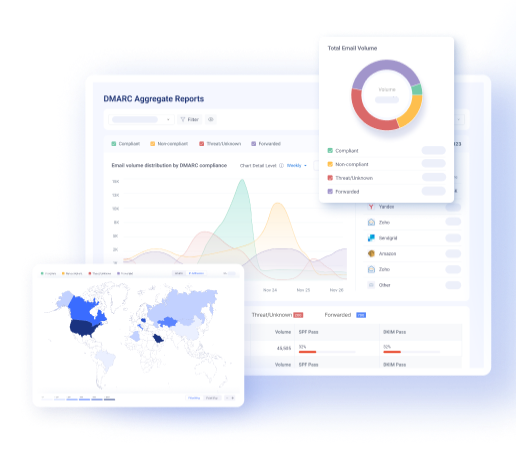
The most effective defense against email spoofing is deploying authentication protocols like SPF, DKIM, and DMARC.
- SPF (Sender Policy Framework) ensures that only approved mail servers can send emails for your domain. You can use EasyDMARC’s SPF Record Generator to produce a new SPF record for your domain.
- DKIM (DomainKeys Identified Mail) adds a cryptographic signature that confirms message integrity. You can create your DKIM record using EasyDMARC’s DKIM Record Generator.
- DMARC (Domain-based Message Authentication, Reporting & Conformance) ties these together, helping domain owners detect and block spoofing attacks before they reach inboxes. You can use EasyDMARC’s DMARC Record Generator to produce a new DMARC record for your domain.
Regularly monitor your DMARC reports to identify unauthorized sending sources and strengthen your policy from “none” to “reject.”
Verify Domains, Links, and Certificates
A large percentage of spoofing attacks rely on users not checking what they click. Always verify website URLs, email domains, and SSL certificates before entering credentials. Train users to inspect the full address instead of trusting display names or partial links.
Organizations can deploy URL filtering and DNS security solutions that block access to suspicious or look-alike domains. For critical transactions, always use secure HTTPS connections and certificate-pinning where possible.
Secure Networks and DNS Infrastructure
To prevent IP, ARP, and DNS spoofing, your network infrastructure must be configured for authentication and integrity. Enable packet filtering, intrusion detection systems (IDS), and network segmentation to reduce exposure.
Use DNSSEC (Domain Name System Security Extensions) to digitally sign DNS records and ensure users are directed to legitimate websites.
Build Continuous Awareness and Incident Readiness
Even the best technical measures fail without informed users. Cybercriminals exploit human error more than system flaws, so regular security awareness training is essential. Educate employees on the meaning of spoofing, how spoofing in cybersecurity operates, and what to do when they suspect a spoof attack.
Create an incident response plan that includes reporting, isolating affected accounts, and reviewing authentication logs. The faster the response, the lower the damage from any spoofing attack.
Final Thoughts: Outsmarting Today’s Spoofing Attacks
Spoofing attacks continue to evolve, exploiting both human and technical weaknesses. By understanding what spoofing means and how it operates across emails, networks, and websites, organizations can strengthen their digital defenses. Enforcing authentication protocols like SPF, DKIM, and DMARC, and regularly monitoring suspicious domains or IPs, helps reduce exposure.
EasyDMARC helps you detect and block spoofing attacks before they reach your inbox. Strengthen your domain’s security and stop impersonation threats with EasyDMARC’s advanced email authentication and reporting tools. Start your free trial today.
Frequently Asked Questions
Spoofing in cybersecurity is a deceptive attack where hackers disguise their identity or digital source to appear legitimate. It can involve emails, websites, IP addresses, or even GPS data. The goal is to trick victims into sharing sensitive information or performing unsafe actions.
Spoofing focuses on falsifying identity, while phishing uses those false identities to steal information. For example, an attacker may spoof an email to appear to be from a bank and then use phishing content to obtain login details. Both are social engineering techniques, but spoofing is often the setup that makes phishing possible.
Check for unusual sender addresses, mismatched URLs, grammatical errors, or urgent requests. Inspect the full email domain before clicking links. Use email authentication tools to verify message origins and always be skeptical of unexpected messages that request credentials or payments.
The main types of spoofing attacks include email, IP, ARP, DNS, caller ID, text, GPS, and face spoofing. Each targets a different layer — from your inbox and network to biometric systems. Learning to recognize these patterns is key to effective spoofing prevention.
Businesses can prevent spoofing attacks by implementing SPF, DKIM, and DMARC policies, training employees, and monitoring DNS records. They should also deploy network protection tools, firewalls, and DNSSEC for added authenticity verification. Regular audits and EasyDMARC reports can help spot threats early.

 We’re glad you joined EasyDMARC newsletter! Get ready for valuable email security knowledge every week.
 You’re already subscribed to EasyDMARC newsletter. Continue learning more about email security with us


